Ory Pricing Explained: aDAU Tiers and Costs at Scale. Ory Network bills on average daily active users (aDAU), not MAU. What aDAU means, Ory tiers, monthly costs at 10k, 100k and 1M users, and self-hosting.
Ory Network bills its paid plans on average daily active users (aDAU), not the monthly active users (MAU) most identity vendors count, so your bill follows how often your users sign in rather than how many different people sign in during the month. There is a free Developer plan, then Production at $770 a year plus $0.14 per aDAU per month and Growth at $9,350 a year plus $0.12 per aDAU per month, with Enterprise priced by quote (Ory pricing). The open source Ory stack (Kratos, Hydra and Keto) is free to self-host, but you pay for the infrastructure it runs on and the people who run it.
Prices as of 18 November 2026, read by hand from Ory’s pricing page. Ory changes its pricing from time to time, so check the page before you put a number in a budget.
This post turns those tiers into monthly bills at 10,000, 100,000 and 1,000,000 users, explains how aDAU is counted and when it works out cheaper or dearer than MAU, shows which features sit on which plan, and compares managed Ory with self-hosting it and with per-MAU vendors such as Cognito and Auth0.
What are Ory Network’s plans and prices?
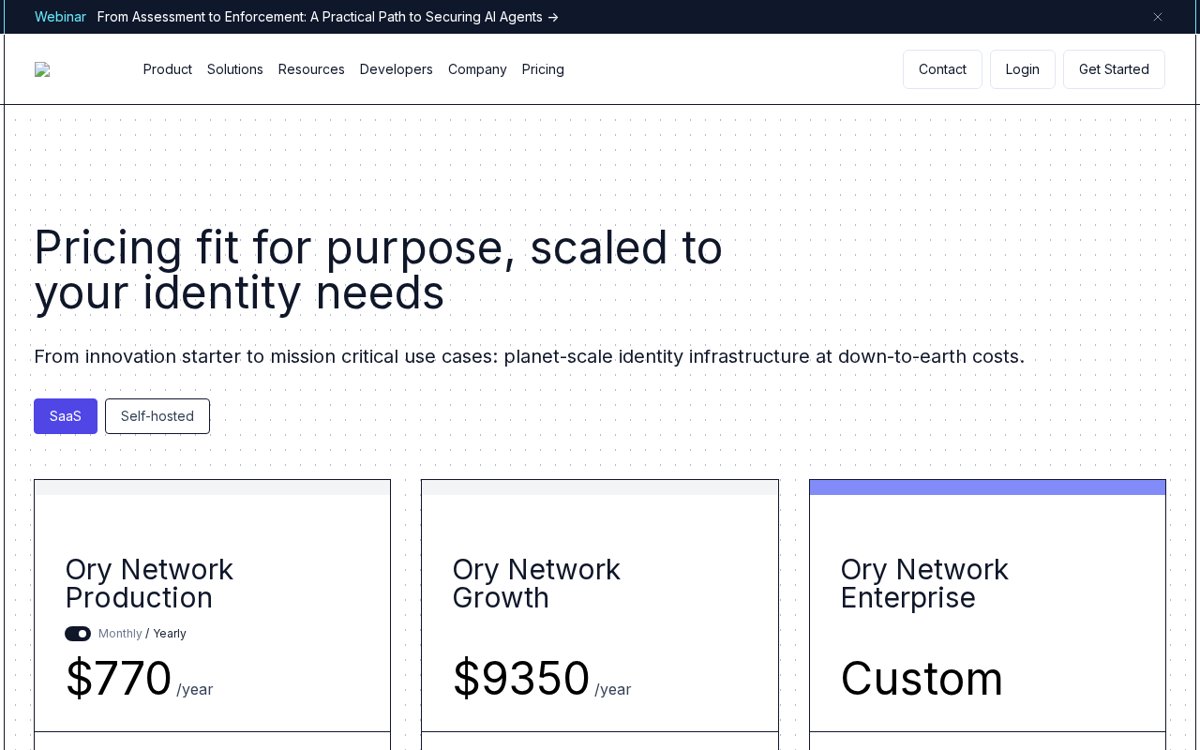
Ory’s pricing page lists four plans for Ory Network, its hosted service, and two licenses for running Ory yourself. Every figure below comes from ory.com/pricing. The screenshot shows the cards for the three paid plans; the free Developer plan appears only in the comparison table further down the page.
| Plan | Base price | Price per aDAU | Included monthly credit | Other usage |
|---|---|---|---|---|
| Developer | Free | Not listed | No | 1 member, 2 development environments, no production or staging environment |
| Production | $770 / year | $0.14 / aDAU / month | $21.00 | M2M tokens $0.007 each, permission checks $0.000090 each |
| Growth | $9,350 / year | $0.12 / aDAU / month | $255.00 | M2M tokens $0.006 each, permission checks $0.000085 each |
| Enterprise | Custom | Committed aDAU usage discounts | Talk to Ory | Custom |
The Developer plan is for building and testing, since it has no production environment. The first plan you can put real users on is Production, so the realistic starting point for a live app is $770 a year (about $64 a month) plus usage.
Usage is billed in three meters. The aDAU meter covers your end users, and the pricing page also prices machine-to-machine (M2M) tokens and permission checks separately. If you use Ory only for user login, the aDAU meter is the one that matters.
The pricing page also lists an included monthly credit ($21 on Production, $255 on Growth), but it does not say how that credit is applied against usage. The worked examples below leave it out, which means they overstate a Production bill by at most $21 a month and a Growth bill by at most $255 a month.
For self-hosting, the same page lists an Ory Enterprise License and an Ory Continuous Security License, both as “Custom Quote”.
What is aDAU, and how is it different from MAU?
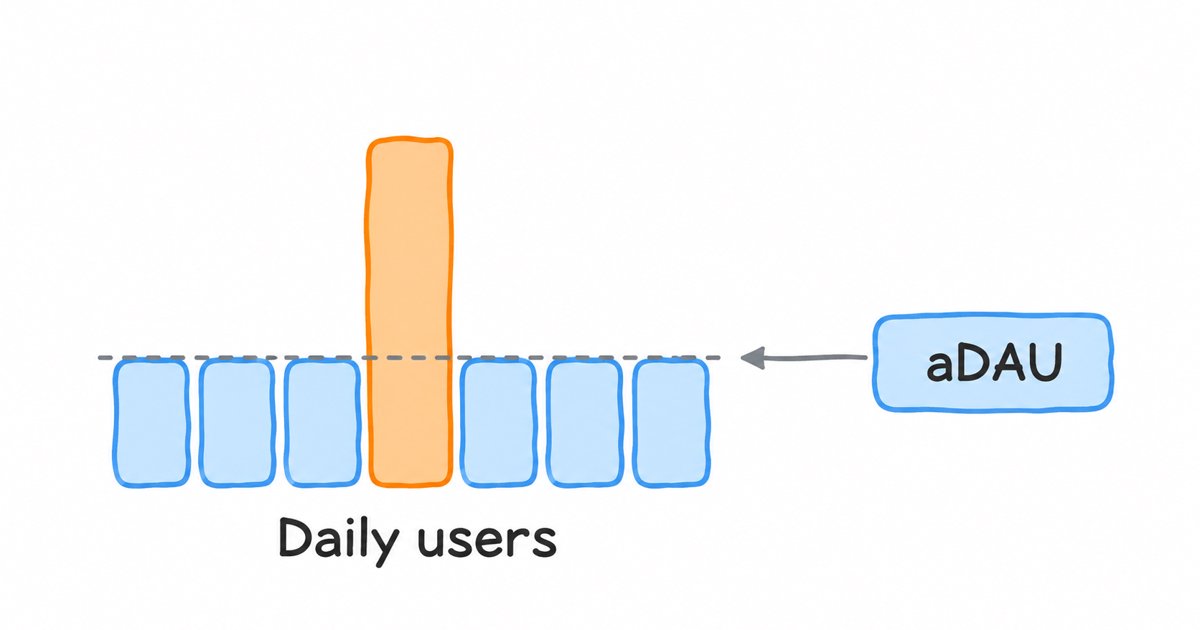
aDAU stands for average daily active users. Ory’s comparison post puts it as “aDAU counts unique authenticated users per day, then averages over the billing period” (Ory, aDAU vs MAU).
MAU works differently. In Ory’s words, “MAU counts every unique user who authenticates at least once in a billing month” (Ory, aDAU vs MAU), and AWS describes Cognito’s MAU the same way: a user counts as a monthly active user if they are active at least once in the month (Amazon Cognito pricing). Under MAU, a person who signs in once and a person who signs in every day each count as one user.
Under aDAU those two people count very differently. Ory’s 2024 announcement gives the arithmetic: a user active every day is 1 aDAU, a user active once a month is “1 DAU / 30 days = 0.03 aDAU”, and a user active five times a month is “5 DAU / 30 days = 0.167 aDAU” (Ory, DAU and MAU pricing). So aDAU is roughly your MAU multiplied by the share of the month an average user is active, which is the ratio product teams call DAU/MAU, or stickiness.
How does a usage spike change the count?
Ory’s own example is a month where 1,000 users are active every day for 29 days and 5,000 users are active on one day. Averaged over the month, that comes to about 1,133 aDAU, while the MAU count for the same month is “at least 5,000 from the spike day alone” (Ory, aDAU vs MAU).
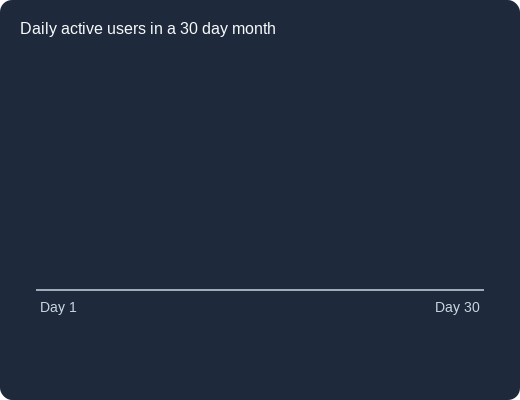
For 29 days, 1,000 users are active each day (1). One day a campaign brings 5,000 users (2). Ory averages the daily counts over the month, which gives about 1,133 aDAU (3), while a monthly active user count for the same month is at least 5,000, because the spike day alone has 5,000 different users (4).
This is why Ory says the model “prevents spikes in usage from disproportionately affecting billing” (Ory, DAU and MAU pricing). A launch, a marketing email or a seasonal peak adds a little to the average instead of setting the bill for the whole month.
When is aDAU cheaper than MAU, and when is it dearer?
It depends almost entirely on your DAU/MAU ratio. Ory’s 2024 post says “the industry sees DAU/MAU ratios between 6% and 20%” (Ory, DAU and MAU pricing), and its 2026 post says that across Ory Network’s customers “the observed average is approximately 7.6%” (Ory, aDAU vs MAU).
You can turn that into an effective price per monthly active user by multiplying the aDAU price by your ratio. On Production at $0.14 per aDAU, a 7.6% ratio works out to about $0.011 per MAU, and a 20% ratio to $0.028 per MAU. Set against a per-MAU price such as Cognito Essentials at $0.015 (Amazon Cognito pricing), Ory’s usage charge is lower while your ratio stays under about 10.7% ($0.015 divided by $0.14), and higher above it. On Growth at $0.12 per aDAU the crossover is 12.5%. These crossovers ignore Ory’s base fee and Cognito’s free tier, which the worked examples below include.
In practice, aDAU favors products people sign in to now and then: customer portals, billing and account pages, booking sites, apps with a large base of occasional or seasonal users, and anything with spiky campaigns. It is less favorable for products people use all day, such as internal tools, B2B work apps, chat and collaboration, or anything that authenticates users against Ory’s APIs many times a day, where the ratio can sit well above 20%.
Before you rely on the cheap end, measure your own ratio. Your analytics tool or your current identity provider’s login events will give you daily and monthly unique users, and dividing the average of the first by the second gives the number every calculation here depends on.
What does Ory Network cost at 10,000, 100,000 and 1,000,000 users?
The table below takes “users” to mean monthly active users, converts them to aDAU at Ory’s observed average ratio (7.6%) and at the top of the industry range Ory quotes (20%), and adds the base fee spread over twelve months ($770 / 12 = $64.17 on Production, $9,350 / 12 = $779.17 on Growth). Prices are from Ory’s pricing page; the arithmetic is ours. It leaves out the included credit, M2M tokens, permission checks and tax.
| Monthly active users | aDAU at 7.6% | Production / month | Growth / month | aDAU at 20% | Production / month | Growth / month |
|---|---|---|---|---|---|---|
| 10,000 | 760 | $171 | $870 | 2,000 | $344 | $1,019 |
| 100,000 | 7,600 | $1,128 | $1,691 | 20,000 | $2,864 | $3,179 |
| 1,000,000 | 76,000 | $10,704 | $9,899 | 200,000 | $28,064 | $24,779 |
A few things stand out from these numbers.
- At 10,000 users Production is cheap, about $171 a month for a typical ratio, and the Growth base fee dominates its total. You would move to Growth for its features, not its price.
- At 100,000 users the usage charge has overtaken the base fee on both plans, and your ratio now changes the bill by more than the plan choice does: the same 100,000 users cost $1,128 or $2,864 a month on Production depending on how often they sign in.
- At 1,000,000 users Growth becomes the cheaper of the two, because its lower per-aDAU price outweighs its higher base fee once you pass about 35,750 aDAU (the $715 monthly difference in base fee divided by the $0.02 difference in unit price). At this size most teams would also ask for an Enterprise quote, since that plan offers committed aDAU usage discounts (Ory pricing).
For comparison, Cognito Essentials at the listed $0.015 per MAU above a free tier of 10,000 MAU (Amazon Cognito pricing) would be $0 at 10,000 users, $1,350 at 100,000 and $14,850 at 1,000,000. At a low ratio Ory comes out cheaper from 100,000 users up, and at a high ratio Cognito does. That comparison is only about price per user: our Cognito scaling post covers the limits and features that tend to matter more as you grow, and Auth0 vs Cognito covers how Auth0’s per-MAU plans compare.
Which features sit behind which Ory tier?
The price per user is only half of the plan decision, because some features that B2B products need are only on the higher tiers. This is what the comparison table on Ory’s pricing page lists for the paid plans.
| Feature | Production | Growth | Enterprise |
|---|---|---|---|
| Uptime SLA | No | No | 99.99% |
| PII region storage selection | Yes | Yes | Yes |
| Multi-region failover | No | No | Yes |
| B2B authentication | No | Yes | Yes |
| B2B SSO (OIDC only) | No | Yes | Yes |
| Flexible API rate limits | No | No | Yes |
| Enterprise support SLA and concierge onboarding | No | No | Yes |
Two rows deserve attention. If you sell to businesses whose employees sign in through their own identity provider, the Growth card lists B2B SSO over OIDC only, so SAML SSO and SCIM provisioning are not part of Growth, and a B2B product that needs them will likely reach a custom quote earlier than its user count suggests. The uptime SLA is also an Enterprise feature. Ory’s 2024 announcement said “the Growth plan now operates under an SLA of 99.9%” (Ory, DAU and MAU pricing), but the current pricing page lists no SLA for Growth, so go by the pricing page and confirm it in writing if you need one.
Authentication methods explained walks through which sign-in methods and protocols a typical app needs, which helps you work out which of these rows apply to you.
Identity management as a service, on open source
Skycloak does what Auth0 and Okta do, SSO, MFA, SCIM, audit logs and enterprise federation, on an open source core. Unlimited users and applications on every plan, no charge per monthly active user, and you can export and self-host whenever you want.
What does it cost to self-host Kratos, Hydra and Keto?
The core Ory services are open source on GitHub: Kratos for identities and self-service flows such as registration, login and recovery, Hydra for OAuth2 and OpenID Connect, and Keto for permissions, as each project’s README describes it. There is no license fee and no per-user charge, so on paper the cost does not grow with users at all.
In practice you pay in three places.
- Infrastructure. Each service runs as its own process with its own database and configuration, so a production setup means several services, a database for each (or a shared, carefully separated one), backups, monitoring and a staging copy. Kratos is API-only: its quickstart says it “doesn’t have a UI or HTML templating engine” (Kratos quickstart), so you also build and host the login, registration and consent screens.
- People. Someone has to upgrade the services, apply security fixes, run database migrations, tune rate limits and answer the pager. For most teams this is the largest cost by far, and it does not show up on a cloud bill. Is self-hosting Keycloak worth it in 2026? breaks down that operating work for an open source identity server, and the same categories apply to Ory.
- Features outside the open source edition. Ory’s open source page lists SAML and OIDC SSO and directory sync as available in open source, but marks token exchange, B2B organizations and the admin onboarding portal as available only with the Enterprise License or on Ory Network, and gives open source a CLI where the Enterprise License adds a GUI. If you need those while self-hosting, you are back to a custom quote (Ory pricing).
Self-hosting tends to pay off when you already run Kubernetes and Go services, have the people to own identity as a production system, and either do not need the Enterprise License features above or are prepared to build them. Keycloak vs Ory compares the work involved with running a single all-in-one identity server instead, and fully managed open source identity providers covers hosted options for open source stacks.
How does Ory pricing compare with per-user rivals like Auth0 and Cognito?
Ory, Auth0 and Cognito all charge in proportion to users, so all three share the basic exposure that your identity bill grows with your user count rather than your revenue. Identity provider pricing risk explains why that matters and how to model it at two and five times your current users.
The difference is in which users count. Cognito counts a person as a monthly active user if they are active at least once in the month (Amazon Cognito pricing), so its bill tracks how many different people you have. Ory counts each person in proportion to how many days they are active, so its bill tracks how engaged those people are. For an app with many occasional users, Ory’s count is a fraction of the MAU count; for an app people open every day, the two converge and Ory’s higher unit price shows.
This means you cannot compare the vendors by looking at their headline unit prices side by side. Convert each one to a monthly bill using your own MAU and your own DAU/MAU ratio, as in the table above, and include the plan you would actually need for features such as SSO, SCIM and an SLA.
What pricing risks should you plan for at scale?
- Your ratio can change. A product that adds a daily feature, a mobile app that refreshes sessions, or a shift from consumer to workplace use can raise your DAU/MAU ratio, and the bill rises with it even if your user count is flat.
- The other meters. M2M tokens and permission checks are billed separately. At Production’s $0.000090 per check (Ory pricing), an app that makes 10 million permission checks a month adds $900, and an architecture that checks permissions on every API call can reach that quickly.
- Rate limits. Ory’s rate limit guide says project rate limits depend on your subscription tier and that a client that exceeds a limit receives a 429 Too Many Requests response, and it warns that “clients that repeatedly exceed rate limits without proper backoff may have their API access temporarily blocked” (Ory rate limits). Flexible limits are listed only on Enterprise (Ory pricing).
- Feature-driven upgrades. As described above, needing SAML SSO, SCIM or an SLA can push you toward Enterprise, where the price is negotiated rather than published. Identity costs that show up after you sign lists the questions to ask before that negotiation.
- Annual commitment. Production and Growth are shown as yearly prices on the pricing page, so check the billing term and what happens to the base fee if you change plans mid-year.
Frequently asked questions
Is Ory free?
The open source Kratos, Hydra and Keto projects are free to download and run (Kratos, Hydra, Keto). Ory Network’s Developer plan is free but has no production environment, so a live app on Ory Network starts on the Production plan at $770 a year plus usage (Ory pricing).
What does aDAU mean?
aDAU means average daily active users: Ory counts unique authenticated users per day, then averages that count over the billing period (Ory, aDAU vs MAU). A user active every day counts as 1, and a user active once in a 30-day month counts as about 0.03 (Ory, DAU and MAU pricing).
How do I estimate my aDAU from MAU?
Multiply your monthly active users by your DAU/MAU ratio. Ory reports an average of about 7.6% across its customers (Ory, aDAU vs MAU), so 100,000 MAU would be roughly 7,600 aDAU, but measure your own ratio, because daily-use products can be several times higher.
Does Ory Network include SAML SSO?
The Growth plan card lists B2B SSO over OIDC only, so SAML SSO and SCIM are not part of Growth, and Production includes no B2B SSO (Ory pricing). Ory’s open source page lists SAML and OIDC SSO and directory sync in the self-hosted open source edition.
Is Ory cheaper than Auth0 or Cognito?
For apps with occasional users and a low DAU/MAU ratio, Ory’s aDAU billing often works out cheaper per user. For apps people use daily, a per-MAU price can be cheaper. Work out the bill at your own user count and ratio, including the plan your feature needs require.
What to do next
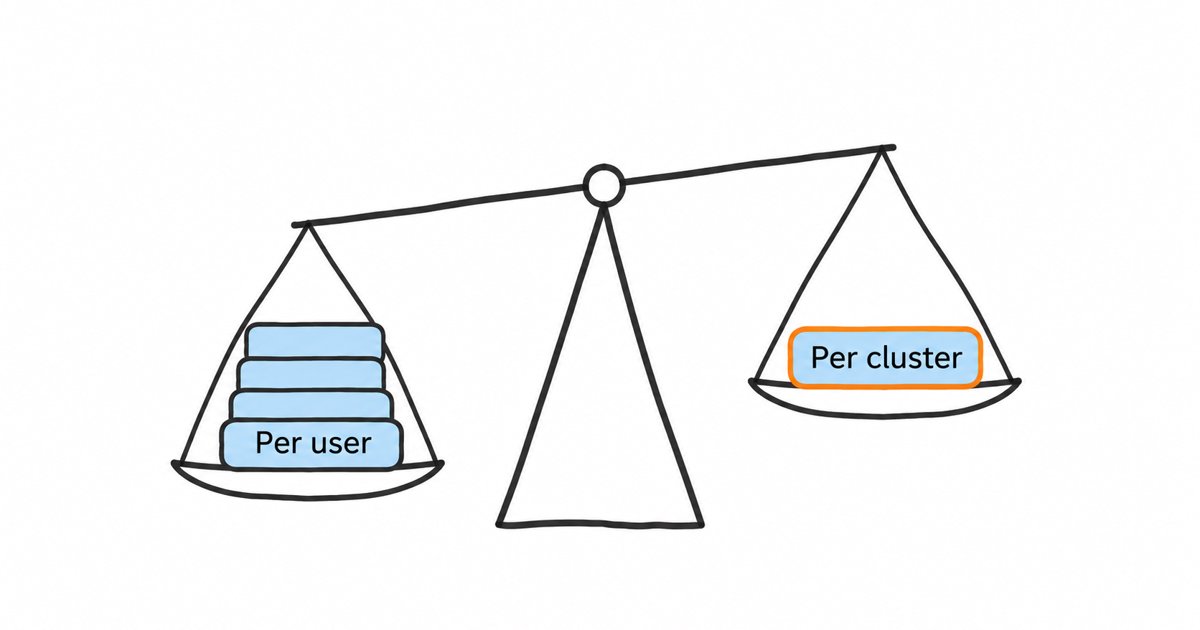
Write down your current monthly active users, your DAU/MAU ratio and the features you need (SSO, SCIM, an SLA, B2B organizations), then work out the monthly bill at your current size and at two and five times it for each pricing approach you are considering: Ory’s aDAU plans, a per-MAU vendor, and self-hosting with its infrastructure and people costs. Then compare the result with a managed Keycloak quote from Skycloak, which is priced by the cluster you run rather than by the number of users who sign in.