
CVE-2026-18963: Keycloak Reset Takeover, PoC and Patches. CVE-2026-18963 lets an unauthenticated attacker take over any Keycloak account via reset. Public exploit code exists. Fixed in 26.4.15, 26.6.6 and 26.7.2.
CVE-2026-18963 is a critical flaw in Keycloak’s reset-credentials flow that lets an unauthenticated attacker complete a password reset for any user without ever clicking the email link, which hands them the account. It carries a CVSS 3.1 base score of 9.1 and is classified as CWE-640, a weak password recovery mechanism. The fix shipped as three patch releases, 26.4.15, 26.6.6 and 26.7.2: users on 26.4.x, 26.6.x and 26.7.x can patch on their own line, while users on 26.0 to 26.3 or 26.5 have no patch on theirs and must move up to 26.4.15 or 26.6.6. As of 28 October 2026, public exploit code for it exists, and no realm setting other than switching off forgot-password mitigates the flaw. If you run any 26.x build older than the patch for its range, treat it as exploitable today and upgrade before you do anything else.
Two things are easy to get wrong about this CVE: its urgency and its fix version. A summary that reduces the advisory to “upgrade to 26.7.2” reads like a forced jump onto the newest minor, and that reading is wrong because the fix was also released as 26.4.15 and 26.6.6. Public exploit code for it now circulates. The sections below cover the exploit status, the fix table, the disclosure timeline, the workaround and the event log queries, in that order.
Is there a public PoC or exploit for CVE-2026-18963?
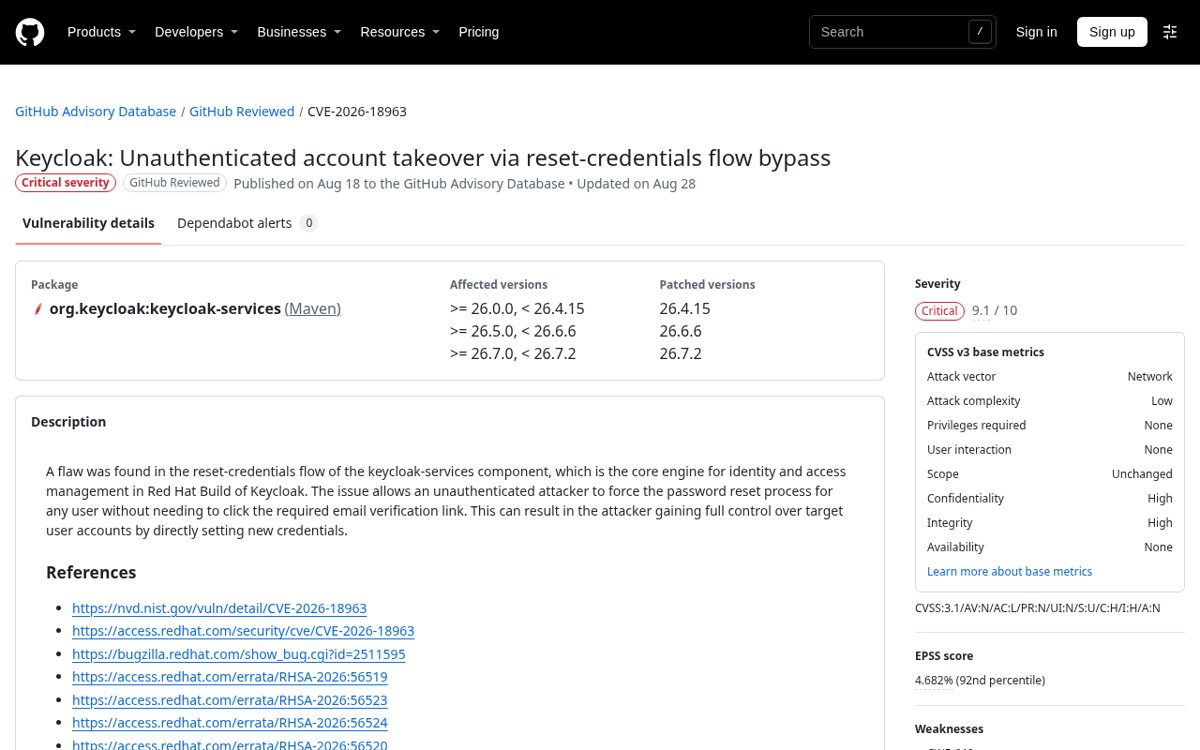
Yes, as of 28 October 2026. The upstream advisory, GHSA-4gv3-mc9p-5wqc, contains no proof of concept and no workaround. Outside it, exploit code has been published on GitHub, and vulnerability trackers now record that. Wiz’s entry for the CVE states plainly that “public exploit code is available” and names the repositories it has seen, among them atiilla/CVE-2026-18963-Exploit and alt3kx/CVE-2026-18963. Another public repository, snizi/cve-2026-18963-exploit describes itself as an “Exploit for KeyCloak CVE-2026-18963”. We have not run any of that code and we have not verified that any of it works, so we are stating that it circulates, not that it is reliable.
Exploitation in the wild is not confirmed. The same Wiz entry records “no confirmed in-the-wild exploitation at time of analysis” from the NVD’s assessment, and that the CVE is “not currently listed in the CISA KEV catalog” (CISA’s Known Exploited Vulnerabilities list). The probability estimate has moved up, though. The advisory now carries an EPSS score of 4.682%, in the 92nd percentile (GHSA-4gv3-mc9p-5wqc), up from the 3.24% and 87th percentile that Wiz recorded at the time of its analysis (Wiz). EPSS estimates the chance of exploitation within the next thirty days, and the percentile is the useful figure: this CVE is rated more likely to be exploited than about nine out of ten scored CVEs.
For patch planning, the practical reading is simple. The attack needs no account, no user interaction and no special setup beyond Forgot password being enabled on the realm, the vulnerable package is the core keycloak-services module, and code that claims to automate it is a search away. Whether the particular repositories work does not change what you should do, because the bar to writing a working exploit from the advisory text was never high. Plan the upgrade as an emergency patch, not as a scheduled change.
What does CVE-2026-18963 actually allow?
An unauthenticated attacker can drive the password reset process for any account they can name and complete it without proving control of the user’s mailbox. GitHub’s advisory, published 18 August 2026, describes a flaw that lets an attacker “force the password reset process for any user without needing to click the required email verification link” (GHSA-4gv3-mc9p-5wqc).
The email link is the entire security control in a forgot-password flow. It is the proof that whoever asked for the reset also controls the mailbox on file. Remove that binding and the flow stops being account recovery and becomes account assignment. Kudelski Security’s analysis describes the root cause as broken step ordering: “intermediate authentication-session state is trusted without sufficiently enforcing that the required verify-email or equivalent action-token step was successfully completed” (Kudelski Security, 24 August 2026).
That is why it is filed as CWE-640, which MITRE defines as a product that “contains a mechanism for users to recover or change their passwords without knowing the original password, but the mechanism is weak” (CWE-640). The CVSS vector, CVSS:3.1/AV:N/AC:L/PR:N/UI:N/S:U/C:H/I:H/A:N, explains the 9.1 component by component: network attack vector, low complexity, no privileges required and no user interaction, so there is no phishing step and no window the attacker has to race. Confidentiality and integrity impact are both high. Availability is scored none, which is why it lands at 9.1 rather than 10.
The affected package is org.keycloak:keycloak-services, the core services module (GHSA-4gv3-mc9p-5wqc). This is not an optional extension or a feature you might not have enabled, and the reset-credentials flow it serves is the one behind the “Forgot password” link.
Which Keycloak versions are affected, and which carry the fix?
The advisory lists three affected ranges and three patched versions, one per active line (GHSA-4gv3-mc9p-5wqc):
| Affected range | Patched version |
|---|---|
| >= 26.0.0, < 26.4.15 | 26.4.15 |
| >= 26.5.0, < 26.6.6 | 26.6.6 |
| >= 26.7.0, < 26.7.2 | 26.7.2 |
Read that table as three parallel patches, not a ladder. If you run 26.4.x, your fix is 26.4.15, and you do not need to touch 26.7 to get it. The same holds for 26.6.x and 26.6.6. The ranges are wider than the lines, though: no patch exists on 26.0 to 26.3 or on 26.5, so those users move up to 26.4.15 or 26.6.6 (snizi/cve-2026-18963-exploit lists no fix on those lines). A patch release on the line you already run is a much smaller change than a minor upgrade, so this is a patch window, not a project.
One caution on the older lines: 26.4.15 and 26.6.6 are tags on the 26.4 and 26.6 lines that the advisory lists as patched, but the exploit repository’s README calls them “vendor backport tags” that “are not interchangeable with community images” (snizi/cve-2026-18963-exploit). If you run a community image, confirm that a 26.4.15 or 26.6.6 tag actually exists for the image you pull before you plan around it, and if it does not, move to 26.7.2 or later.
This detail gets lost when a CVE is summarized down to a single “fixed in” number. A widely repeated assumption about Keycloak is that only the newest minor receives security work, which would make every critical CVE a forced minor upgrade with its staging pass attached. The project’s own policy only commits to fixing in the current or the following minor release: “Depending on the severity of a vulnerability, the issue may be fixed in the current major.minor release of Keycloak, or for lower severity vulnerabilities or hardening in the following major.minor release” (Keycloak SECURITY.md). This CVE was backported anyway, as the advisory’s three patched versions show, and the useful habit is to check the newest tag on the line you actually run before you assume a fix is out of reach.
Backports are not a guarantee, though, and the same policy document points teams that cannot upgrade regularly at Red Hat build of Keycloak, “which offers long term support of specific versions” (Keycloak SECURITY.md). If you need a pinned version with a contractual patch commitment, your cadence follows Red Hat’s lifecycle rather than upstream tags.
When was it disclosed and fixed?
The dates matter for two reasons: they bound the window you need to review in your logs, and they show how quickly exploit code followed the advisory. The tag and release dates below are the ones each linked GitHub release page shows, and the CVE counts are the security fixes those release notes list.
| Date | Event |
|---|---|
| 11 August 2026 | The 26.4.15 and 26.6.6 tags are created, carrying the fix on the older lines |
| 18 August 2026 | The advisory, GHSA-4gv3-mc9p-5wqc, is published and the CVE becomes public |
| 19 August 2026 | Keycloak 26.7.2 ships with the fix for the current line |
| Within days of 18 August | Exploit code appears on GitHub, later recorded by Wiz |
| 24 August 2026 | Kudelski Security publishes a root cause analysis with detection guidance |
| 31 August 2026 | Keycloak 26.7.3 ships with twenty further CVE fixes, none of them for this flaw |
| 16 September 2026 | Keycloak 26.7.4 ships with six further CVE fixes, none of them for this flaw |
Note the week between the older-line tags and the public advisory. A 26.4 or 26.6 deployment that took the new tag in that week carried the fix before the flaw was public, without knowing why. That is the strongest argument for treating point releases as routine maintenance rather than as events.
Does 26.7.3 or 26.7.4 change anything for this CVE?
No. Neither release touches the reset-credentials flow or mentions CVE-2026-18963: the 26.7.3 notes list twenty other CVEs and the 26.7.4 notes list six, none related to password reset. 26.7.2 is the complete fix on the 26.7 line, and 26.4.15 and 26.6.6 are complete on theirs.
That said, if you are on 26.7 and still below 26.7.2, there is no reason to stop at 26.7.2. Going straight to the newest 26.7 patch gets you this fix plus everything since, in one window. Read the 26.7.4 breaking changes in the upgrading guide before you go (Keycloak Upgrading Guide, “Migrating to 26.7.4”). See also our 26.7.3 patch checklist and 26.7.4 patch checklist.
Am I exposed, and how do I check?
Check your running version first, then decide. Everything else is secondary to that number.
Get the version from the running server rather than from the image tag, since latest and pinned-then-rebuilt tags drift.
Once you have it, compare against your line’s patched version in the table above. There are three outcomes:
- At or above the patched version for your line. You have the fix. Nothing further is required for this CVE.
- Below it, on 26.4.x, 26.6.x or 26.7.x. Upgrade to your line’s patch release today. This is a patch release on your current line, so the change is small.
- On 26.0 to 26.3 or 26.5. No patch exists on your line, so move up to 26.4.15 or 26.6.6, which is a minor upgrade rather than a patch.
- Below 26.0 entirely. You are outside every range in the advisory, and the exploit repository’s README says the vulnerable code arrived in 26.0.0, so older builds are not affected by this bug (snizi/cve-2026-18963-exploit). They are still unsupported and exposed to other CVEs, so start the larger upgrade conversation anyway.
Is there a workaround if I cannot upgrade immediately?
There is no realm setting, feature flag or authentication flow tweak that fixes this in place. The strongest interim control is removing the exposed surface: switching off forgot-password on the realm until you can upgrade. In the admin console that is the “Forgot password” switch under Realm settings, on the Login tab, which the Keycloak documentation describes this way: “If you enable Forgot password, users can reset their login credentials if they forget their passwords or lose their OTP generator” (Keycloak Server Administration Guide, “Enabling forgot password”). With the switch off, the link and the flow behind it are gone.
If you manage realms from the command line, the same change is one call per realm with the admin CLI, as Kudelski Security’s write-up shows (Kudelski Security):
kcadm.sh update realms/REALM -s resetPasswordAllowed=falseThis is a genuine availability tradeoff. Users lose self-service recovery and your support desk absorbs the resets while it is in place, so treat it as a bridge measured in days, not as a substitute for the patch.
If you cannot drop self-service recovery even for days, Kudelski Security lists two weaker interim controls: “restricting network exposure of Keycloak login-action endpoints to trusted networks”, and “using a web application firewall or equivalent security control to restrict and rate-limit access to reset-credential endpoints”, which for Keycloak means the path /realms/{realm}/login-actions/reset-credentials (Kudelski Security). Neither closes the flaw; they shrink who can reach it and how fast they can try.
How do I detect an attempt in the Keycloak event log?
Turn on user events if they are not already on. Check first whether the realm saves user events at all, and for how long, because a realm that does not persist them leaves you nothing to search. See also our Keycloak auditing and event logging guide.
The events to search are these. The right-hand column is our reading of each name, so check it against the event types section of the Server Administration Guide (Keycloak Server Administration Guide, “Event types”):
| Event | What it usually indicates |
|---|---|
SEND_RESET_PASSWORD |
A reset was requested for a user and the email was sent |
RESET_PASSWORD |
The reset flow completed |
UPDATE_CREDENTIAL |
A credential changed, with credential_type saying which (here, password) |
UPDATE_PASSWORD |
The older password change event, now deprecated |
The last row catches people out. The upgrading guide’s notes for 26.0 include a section on new generalized event types for credentials (Keycloak Upgrading Guide, “New generalized event types for credentials”), so read it to see which of these names your build records for a password change. A detection rule written a few versions ago that keys only on UPDATE_PASSWORD may be watching for something your build no longer records, so search for both names.
You can read these in the admin console under Events, on the User events tab, filtered by type, or query them from wherever you forward them. Be honest about what the log can and cannot tell you. A successful attack is a password reset that completed, which is exactly what a legitimate reset looks like, and we know of no field on RESET_PASSWORD or UPDATE_CREDENTIAL that records whether the email link was clicked. What you can do is look for the shape of abuse rather than a single event. Kudelski Security’s indicators are the useful starting set (Kudelski Security):
- Password changes without the verification step in the same session. Their key indicator is
UPDATE_PASSWORDevents “that are not preceded by a corresponding VERIFY_EMAIL or EXECUTE_ACTION_TOKEN event within the same user session” (Kudelski Security). On 26.x, apply the same correlation toUPDATE_CREDENTIALwith apasswordcredential type. - Volume from one source. Their wording is “a high volume of RESET_PASSWORD attempts against multiple accounts from a single IP address or client identifier” (Kudelski Security). Our own suggestion is to run the same search on
SEND_RESET_PASSWORDas well. - Resets on accounts that never asked. Resets on realm admins, service-desk operators and other privileged accounts, followed by logins from new devices or locations.
If your mail provider keeps delivery and click data, correlating it with the reset timestamps is the one avenue that sometimes gives a clear answer, because a reset that completed before the email was opened, or without it being opened at all, is not a user’s reset.
Patched on the day, not on your next maintenance window
Keycloak 26.7.2 fixed CVE-2026-18963, an account takeover through password reset. Skycloak had it available for auto-upgrade and told customers the same day upstream shipped it. Self-hosted teams schedule that work themselves.
What should I do if I was running an affected version?
Assume you cannot prove you were not exploited, and plan accordingly. That is uncomfortable, but with exploit code public and logs that cannot separate a bypassed reset from a real one, it is the honest position for most deployments.
- Patch first. Everything else is pointless while the flow is still open.
- Pull the reset events for your exposure window. Start from the date you deployed an affected version, or from 18 August 2026 if you want to bound it to public disclosure, and remember that the advisory date is when the flaw became public, not when it became exploitable. Run the three searches above over that window.
- Force a credential reset for high-value accounts. Realm admins, service-desk operators and anyone with delegated admin rights. If you cannot rule out exposure, rotating a few dozen privileged credentials is cheap relative to the alternative.
- Revoke sessions, not just passwords. Do not assume that changing a credential ended the sessions already open on that account. The admin guide’s section on managing user sessions covers revoking them (Keycloak Server Administration Guide). See also our post on revoking a single Keycloak session.
- Review customizations to the reset-credentials flow. Custom authenticators or a modified reset flow change the code path here. If you have built on it, re-read what you built against the patched behavior rather than assuming the upgrade covers your extension too.
If you delegate password resets to a help desk through fine-grained admin permissions, also read our write-up of CVE-2026-97177, a separate flaw in which, with Fine-Grained Admin Permissions enabled, a delegated administrator “who should be restricted from resetting passwords” can still “change a user’s credentials and take over their account” (CVE-2026-97177 record). The two bugs reach the same outcome, an account whose password someone else set, from opposite ends: one needs no account at all, the other needs a limited admin one.
How do you reduce the blast radius of the next password reset bug?
Password reset is a permanent piece of attack surface, so the durable answer is reducing how much a reset password is worth rather than hoping the flow is bug-free.
Multi-factor authentication is the direct control. If a realm requires a second factor, an attacker who resets a password still has to defeat it, and a CWE-640 flaw stops being a one-step takeover. That is not theoretical here: this CVE gives an attacker the password and nothing else.
Passkeys go further by removing the shared secret. There is no password to reset, so the reset-credentials flow stops being a path to the account at all. Our Keycloak passkeys and WebAuthn guide covers the implementation.
Password policy is the weakest lever against this particular CVE: a policy governs what a password may be, and this flaw does not care what the password is, only who gets to set it. See also our Keycloak security audit and hardening checklist.
Where does managed Keycloak change this, and where doesn’t it?
The upgrade itself is the part a managed service removes. On a managed service, building and rolling out the patched image is the provider’s job rather than yours, and that work is where much of the elapsed time between a CVE landing and a fleet being patched goes.
What it does not remove is the incident question. If you ran an affected version before migrating, the review of your own reset events, your own privileged accounts and your own custom flows belongs to you, because it depends on your users and your history. Moving to a managed service shortens future exposure windows, but it has no effect on one that already happened, so the steps above stay on your list either way.
FAQ
Is there a public exploit for CVE-2026-18963? Yes. As of 28 October 2026, exploit code is public on GitHub, among it the snizi/cve-2026-18963-exploit repository, and vulnerability trackers such as Wiz record that “public exploit code is available”. We have not run or verified any of it. The advisory itself contains no proof of concept.
Is CVE-2026-18963 being exploited in the wild? There is no confirmed report. The CVE is not in CISA’s Known Exploited Vulnerabilities catalog and NVD recorded no confirmed in-the-wild exploitation at the time of its analysis. With public exploit code, an unauthenticated vector and an EPSS score in the 92nd percentile, you should not wait for that confirmation before patching.
Do I have to upgrade to 26.7.2 specifically? No. The fix was backported, so 26.4.15 patches the 26.4 line and 26.6.6 patches the 26.6 line. On 26.4.x or 26.6.x, pick the patch release on your line; on 26.0 to 26.3 or 26.5 there is no patch on your line, so move up to 26.4.15 or 26.6.6. If you are on 26.7, go to the newest 26.7 patch rather than stopping at 26.7.2.
Does 26.7.3 or 26.7.4 contain an additional fix for this CVE? No. Neither release mentions CVE-2026-18963 or the reset-credentials flow. They fix other CVEs, which is a reason to take them, but 26.7.2 is the complete fix for this one.
Does disabling forgot-password protect me? It removes the exposed flow, which is a real mitigation if you genuinely cannot patch within a day or two. It is not a fix, and it costs you self-service recovery while it is in place.
Can I tell from my logs whether an account was taken over this way?
Not with certainty from Keycloak’s events alone, because a bypassed reset produces the same RESET_PASSWORD and UPDATE_CREDENTIAL events as a legitimate one. Correlating password changes with the verification events in the same session, looking for reset volume from one source, and matching against your mail provider’s click data are the approaches that sometimes give an answer.
Does MFA stop this CVE? It does not prevent the password reset, but it stops the reset from being sufficient to sign in. An attacker who exploits this against an MFA-enrolled account holds a password and still faces the second factor.
We’re on a version below 26.0. Are we safe? Probably not from this bug, but they are not safe in general. Versions below 26.0 fall outside the advisory’s ranges, and the exploit repository’s README says the vulnerable code arrived in 26.0.0 (snizi/cve-2026-18963-exploit). Those versions are unsupported and exposed to other CVEs, so plan the move to a patched line anyway.
What to do now
Check the running version of every Keycloak you operate against the fix table, upgrade to your line’s patch today, and pull the reset events for your exposure window with the three searches above. If you cannot patch within a day or two, switch off forgot-password on the exposed realms until you can. And if you would rather not track Keycloak CVEs and patch windows yourself, Skycloak’s managed Keycloak rolls the patched build for you.
Sources
- GitHub Advisory Database, “Keycloak: Unauthenticated account takeover via reset-credentials flow bypass” (GHSA-4gv3-mc9p-5wqc, CVE-2026-18963), published 18 August 2026, retrieved 2026-10-28, https://github.com/advisories/GHSA-4gv3-mc9p-5wqc
- Wiz Vulnerability Database, CVE-2026-18963, retrieved 2026-10-28, https://www.wiz.io/vulnerability-database/cve/cve-2026-18963
- Snizi, “Exploit for KeyCloak CVE-2026-18963” (GitHub repository, not verified by us), retrieved 2026-10-29, https://github.com/snizi/cve-2026-18963-exploit
- Kudelski Security, “CVE-2026-18963: Keycloak credential reset authentication bypass”, 24 August 2026, retrieved 2026-10-28, https://kudelskisecurity.com/research/cve-2026-18963---keycloak-credential-reset-authentication-bypass
- MITRE, CWE-640: Weak Password Recovery Mechanism for Forgotten Password, retrieved 2026-10-28, https://cwe.mitre.org/data/definitions/640.html
- Keycloak, SECURITY.md, retrieved 2026-10-28, https://github.com/keycloak/keycloak/blob/main/SECURITY.md
- Keycloak, tags 26.4.15 and 26.6.6, 11 August 2026, retrieved 2026-10-28, https://github.com/keycloak/keycloak/releases/tag/26.4.15 and https://github.com/keycloak/keycloak/releases/tag/26.6.6
- Keycloak, release 26.7.2 notes, 19 August 2026, retrieved 2026-10-28, https://github.com/keycloak/keycloak/releases/tag/26.7.2
- Keycloak, release 26.7.3 notes, 31 August 2026, retrieved 2026-10-28, https://github.com/keycloak/keycloak/releases/tag/26.7.3
- Keycloak, release 26.7.4 notes, 16 September 2026, retrieved 2026-10-28, https://github.com/keycloak/keycloak/releases/tag/26.7.4
- Keycloak, Server Administration Guide (Forgot password setting, revoking active sessions, auditing events), retrieved 2026-10-28, https://www.keycloak.org/docs/latest/server_admin/index.html
- Keycloak, Upgrading Guide, “New generalized event types for credentials” and the 26.7.4 breaking changes, retrieved 2026-10-28, https://www.keycloak.org/docs/latest/upgrading/index.html#new-generalized-event-types-for-credentials
- CVE Program, CVE-2026-97177 record, retrieved 2026-10-28, https://www.cve.org/CVERecord?id=CVE-2026-97177