What's New in Keycloak 26.8: The Full Release Roundup. Every Keycloak 26.8 change in one place, sorted by upgrade impact: breaking changes, defaults, features, deprecations, 26.8.1 and 26.8.2 fixes, a checklist.
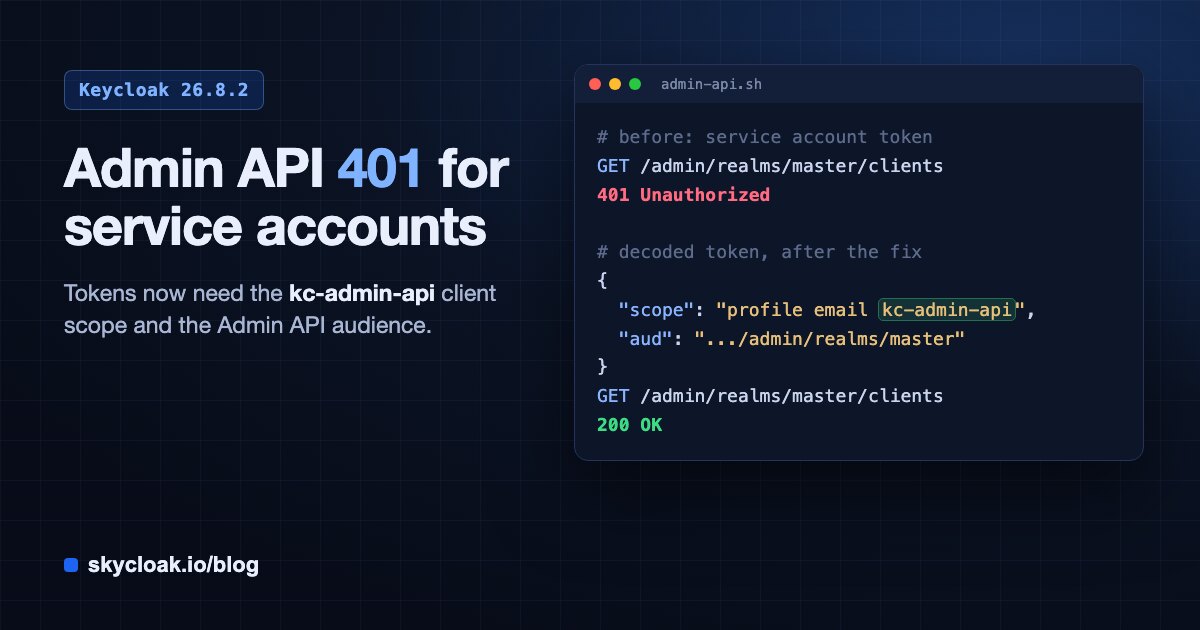
Keycloak 26.8 is a feature release in the Keycloak 26 line, released on 1 October 2026. (Keycloak 26.8.0 released, 26.8.0 release) It promotes the SCIM API and client secret rotation to supported and turns both on by default, promotes token exchange delegation to preview with client delegation for AI agents, adds an experimental OpenID4VP verifier, and keeps the stricter OIDC redirect URI check that rejects URIs already carrying state, code or other response parameters (26.8.0 release notes). The two patch releases so far change behavior too: 26.8.1 stops one SAML client from ending another client’s sessions through single logout (26.8.1 release), and 26.8.2 makes the Admin REST API accept only tokens that carry the new kc-admin-api scope (upgrading guide).
This roundup is for you if you already run a 26.x cluster and want to know what 26.8 changes before you move to it. We sorted every notable change by what it means for an upgrade: what can break, which defaults moved, what is new, what is deprecated, and what the patch releases fixed. Each item links to the official note or code change it comes from, and where we have written a deep dive on a change, the item links to that as well. At the time of writing the newest patch is 26.8.2, released on 5 November 2026 (Keycloak 26.8.2 released, 26.8.2 release).
What changed in Keycloak 26.8 at a glance?
The table lists the changes most likely to matter on an existing cluster, with the release that brought them and our post on each where one exists.
| Change | Release | Upgrade impact | Detail |
|---|---|---|---|
| SCIM API supported and enabled by default | 26.8.0 | New default | Keycloak 26.8 SCIM API |
| Client secret rotation supported and enabled by default | 26.8.0 | New default | Client secret rotation in 26.8 |
| Token exchange delegation promoted to preview, with client delegation | 26.8.0 | New, and breaking for 26.7 testers | Token exchange delegation for AI agents |
| OpenID4VP verifier | 26.8.0 | New (experimental) | OpenID4VP for EUDI relying parties |
| OIDC parameters rejected in redirect URIs | 26.7 lines, carried into 26.8.0 | Breaking | Redirect URI parameter pollution |
| Identity provider mappers can no longer grant admin roles by default | 26.8.0 | Breaking | This post |
| Login failures stored in the database | 26.8.0 | New default | This post |
| SAML single logout limited to sessions the issuer owns | 26.8.1 | Fix | 26.8.1 SAML logout fix |
| Admin REST API audience check | 26.8.2 | Breaking | 26.8.2 Admin API 401 fix |
Which Keycloak 26.8.0 changes can break an existing setup?
The upgrading guide lists six breaking changes for 26.8.0, meaning changes that may need you to update configuration or applications (changes in 26.8.0). Several are security fixes, and they tend to hit automation and delegated administrators rather than end-user logins.
- Client secrets are hidden from view-only admins. The client endpoints of the Admin REST API return a masked
**********instead of the secret when the caller only hasview-clients. If a script reads client secrets with a read-only role, give itmanage-clientsor the equivalent fine-grained permission. - The
initiating_idplogout parameter is ignored. Keycloak now always logs the user out of the upstream identity provider during a browser logout. Theallow-initiating-idp-logout-paramserver option brings the old behavior back for now, but it is deprecated, so plan to move to OIDC back-channel or front-channel logout instead. - X.509 user authentication needs a CA subject DN. The user-facing X.509 authenticators gain a required Certificate Authority subject DN option that names the CAs you trust for user certificates. Old configurations keep working in 26.8, but the notes say the new behavior will be enforced in the next major version.
- Disabled clients leave the token audience. A disabled or removed client is no longer added to
aud, and its roles no longer appear inresource_access. Tokens are still issued, so logins keep working, but a resource server that expected that audience will start rejecting them. This addresses CVE-2026-93999. - Authorization Services normalizes resource URIs. Matrix parameters, dot segments, encoded slashes, trailing slashes, query strings and fragments are now removed or resolved before a request is matched to a resource. If your policies relied on telling two such forms apart, review them.
- Identity provider mappers no longer grant admin roles by default (CVE-2026-12388). Every identity provider gets an
allowAdminRoleMappingsetting that defaults to off, including the ones that exist when you upgrade. A mapper that grants an administrative role, or adds a user to a group that carries one, is blocked until an administrator withmanage-realmenables Allow granting admin roles via mappers on that provider.
The redirect URI check belongs on this list too, even though it is older than 26.8. Keycloak rejects any redirect_uri or post_logout_redirect_uri that already contains an OIDC response parameter such as state, code or session_state, in the query string or the fragment, and the opt-outs allow-oidc-params-in-redirect-uris and the allow.oidc.params.in.redirect.uris client attribute “will be removed in Keycloak 27” (upgrading guide for 26.7.3, changes in 26.7.3). If you are coming from a release before the check arrived, our post on the redirect URI change shows which versions have it and how to find the clients that break.
Teams that tried token exchange delegation in 26.7 have two more breaking changes: delegation is now authorized only through Fine-Grained Admin Permissions V2 (the delegate and delegate-members scopes) instead of the impersonation role, and the scope was renamed from delegation to delegation:user, so delegation:admin1 becomes delegation:user:admin1 (upgrading guide, changes in 26.8.0).
Which defaults changed in Keycloak 26.8 and need review?
Several notable changes in 26.8.0 are not labelled breaking but change what a running cluster does, so they deserve a look before production (changes in 26.8.0).
- Login failures live in the database. Brute force detection data is now stored in the database by default, so a locked-out user stays locked out across restarts. The notes warn that you “may observe increased database connection usage and higher CPU usage on the database” (changes in 26.8.0). The old in-memory behavior is still available as
login-failures:v1, but it is deprecated and does not work with thestatelessfeature. - SCIM API and client secret rotation are on. Both features are now enabled by default, so
--features=scim-apiand--features=client-secret-rotationare no longer needed (changes in 26.8.0). The server administration guide says you “must also enable SCIM for each realm individually” (managing SCIM), as our SCIM post explains. --features=previewno longer enablesstateless. Becausestatelessis now supported, it has to be named explicitly with--features=stateless. It also now refuses to start unless--cache-embedded-cluster-nameis set to something other than the defaultISPN(upgrading guide, changes in 26.8.0).- Refresh tokens show the session idle timeout. Offline refresh tokens now always carry an
expclaim, and for all refresh tokensrefresh_expires_inis capped by the user session idle timeout. Clients that refresh on a timer may start refreshing earlier, which is the intended effect. - Role mapping is visible to whoever can map the role. An administrator who can map a role can now view it, and some client-level role mapping endpoints return an empty list instead of
403 Forbidden(upgrading guide, changes in 26.8.0). - Client session listings filter by user visibility. Callers without
view-usersnow see fewer sessions from the client session endpoints (upgrading guide, changes in 26.8.0). - The login page’s identity provider buttons were redesigned. Custom themes that override
social-providers.ftlor style the provider icons may render incorrectly, so check your login theme (upgrading guide, changes in 26.8.0). - Quarkus moved from 3.33 to 3.40. No configuration change is needed, but custom extensions that depend on Quarkus internals should be retested (upgrading guide, changes in 26.8.0).
There is also a database detail for large deployments. The OFFLINE_USER_SESSION table gets a new column and rebuilt indexes, and if the table has more than 300,000 entries, Keycloak skips the index creation during migration and logs the SQL instead (upgrading guide, changes in 26.8.0). New in 26.8, Keycloak then creates those skipped indexes in the background after startup on PostgreSQL, Oracle, MySQL, MariaDB and the Microsoft SQL Server editions that support online index creation (release notes, 26.8.0 release notes). On other databases, or with the manual or validate migration strategy, you still run the logged SQL yourself.
If you want a broader pass over cluster settings while you are at it, our list of default configurations to adjust on a Keycloak cluster is a good companion to this section.
What is new or promoted in Keycloak 26.8?
The release notes group the headline features into security and standards, administration, and running Keycloak (26.8.0 release notes). The features guide says that “some supported features, and all preview features, are disabled by default”, and that preview features “are disabled by default and are not recommended for use in production” (Keycloak features guide).
Now supported:
- SCIM API. The inbound SCIM 2.0 API for users and groups moves from preview to supported, with multivalued user attributes, User Profile permissions, fine-grained admin permissions in search filters and better performance on large user bases. Details are in our SCIM post.
- Client secret rotation. A confidential client can hold two active secrets at once, configured through client policies, so applications can switch to the new secret before the old one stops working. The server administration guide notes that rotations “do not occur automatically or through a background process” (client secret rotation), which our rotation guide covers.
- Multi-cluster v2. Two or more clusters can be connected without an external Infinispan cluster by enabling
stateless, which keeps session data in the database. It is off by default, and a new guide covers bare-metal and VM deployments (26.8.0 release notes).
Now preview:
- Token exchange delegation. A user can consent to a specific client, such as an AI agent, acting on their behalf through the new
delegation:clientparameterized scope, and the resulting token carries anactclaim naming the client. The notes stress that client delegation “does not grant Admin API access even if the client holds service account credentials”. Our delegation post walks through the flow. - Parameterized scopes, formerly dynamic scopes, which let a client send a value with a scope name, such as
project:12345. - OID4VCI credential issuance, now with revocation when refresh tokens are revoked and an application-initiated action for requesting a credential.
- Client Admin API v2, with strict validation and an accurate OpenAPI description, which the Keycloak Operator uses for its
KeycloakOIDCClientandKeycloakSAMLClientresources.
Experimental:
- OpenID4VP verifier. Keycloak can accept a credential presentation from a digital wallet at login, behind the
oid4vc-vpfeature. Our OpenID4VP post covers what it supports and what an EUDI relying party still needs. - Shared Signals Framework events for accounts being disabled and enabled, a Vert.x-based outbound HTTP client (
http-client:v2), mdoc credentials and a Helm chart for installing the Operator (release notes, 26.8.0 release notes).
Other additions worth knowing about:
- Identity providers can be linked to more than one organization, and domain routing moved from the identity provider to each organization domain. Existing links are migrated with the Managed membership type, while new links default to Unmanaged (release notes, 26.8.0 release notes).
- Encrypted PKCS#8 private keys in PEM format work for HTTPS, with
--https-certificate-key-file-password(release notes, 26.8.0 release notes). - New
--cache-embedded-cluster-nameand--cache-embedded-node-nameoptions replace the low-level SPI options, and the Operator now sets the node name to the pod name (release notes, 26.8.0 release notes). - An
invite-userworkflow step sends an invitation email when a user is created. - Impersonated tokens now carry an
actclaim, and token events record the impersonator. - Two new client policy executors:
allowed-protocol-mapperslimits which mapper types the Admin REST API can create, and the opt-insecure-client-node-hostnameprotects the legacy adapter node registration endpoint against server-side request forgery.
What did Keycloak 26.8 deprecate?
Deprecated features still work in 26.8, but each one is scheduled for removal, so these are the items to plan for before Keycloak 27 (deprecated features in 26.8.0).
- The Full scope allowed switch on clients. Keycloak now logs a
WARNat token issuance for every client that still has it on, except the built-insecurity-admin-consoleandadmin-cli. The notes recommend turning it off on your own clients and adding explicit role scope mappings, and they advise against turning it off on the two built-in admin clients by hand, because that “can break Admin Console login immediately” (upgrading guide, changes in 26.8.0). - Multi-cluster v1 (the
multi-sitefeature), replaced bystateless. The experimentalclusterlessfeature will also be removed (upgrading guide, changes in 26.8.0). - Volatile sessions, meaning
--features-disabled=persistent-user-sessions, and the in-memorylogin-failures:v1(upgrading guide, changes in 26.8.0). - The client registration providers
default,installandsaml2-entity-descriptor, which now log a warning whenever they are called (upgrading guide, changes in 26.8.0). - Server-side key pair endpoints under the client certificates API, which no longer store private keys (upgrading guide, changes in 26.8.0).
- The introspection
jwtextension, the Use refresh tokens for client credentials grant switch, three switches under OpenID Connect Compatibility Modes, the Revalidate Client Certificate option for X.509 user authentication, Kerberos credential delegation, and the load balancer route in theAUTH_SESSION_IDcookie (upgrading guide, changes in 26.8.0).
The Keycloak Realm Operator also reached end of life, with KeycloakRealmImport and the preview client resources of the main Operator as its replacements (upgrading guide, changes in 26.8.0). To find deprecated server options in your own configuration, our guide to finding and replacing deprecated Keycloak options shows how to read the warnings Keycloak prints at startup.
Managed identity, built on open source
Skycloak runs real upstream Keycloak for you, so you get SSO, MFA and SCIM without operating the infrastructure. Unlimited users on every plan, no fork, and you can export at any time.
What do the Keycloak 26.8.1 and 26.8.2 patch releases change?
Both patches carry breaking changes, which the upgrading guide explains: “In minor or patch releases, Keycloak will only introduce breaking changes to fix bugs” (changes in 26.8.1). Almost all of them close security gaps, so it is worth going straight to the latest patch rather than stopping at 26.8.0.
Keycloak 26.8.1 was released on 13 October 2026 (Keycloak 26.8.1 released, 26.8.1 release). Its notable changes are:
- SAML single logout. The SLO endpoint now rejects a LogoutRequest whose SessionIndex belongs to a different client than the one sending it. Before, a client could end the single sign-on session of a user who had never signed in to it. The 26.8.1 release lists the fix as issue 53116, and our 26.8.1 post explains what it takes to exploit and what to test.
- SMTP StartTLS is enforced (CVE-2026-107121). With Enable StartTLS on, Keycloak no longer falls back to plaintext when the server does not offer STARTTLS, so email fails instead.
- Back-channel logout tokens from OIDC identity providers must be signed (CVE-2026-18569), whatever the Validate Signatures setting says, so a provider with validation off needs a JWKS URL or a public key.
- An identity provider’s client secret must be re-sent when an update changes where it goes, such as
tokenUrlorclientId(CVE-2026-15943). Scripts that update those fields withkcadm.shnow need to passconfig.clientSecretas well. - X.509 fixes: key usage and extended key usage are validated correctly, CRL files load only from the
confdirectory, and CRL and OCSP responses are capped at 10 MB by default (upgrading guide). - Semicolons are no longer query parameter delimiters, and the Conditional OTP option Skip OTP for Header now requires a trusted proxy (upgrading guide).
Keycloak 26.8.2 was released on 5 November 2026 (Keycloak 26.8.2 released, 26.8.2 release, changes in 26.8.2). The ones most likely to affect you are:
- The Admin REST API checks the audience. Tokens must carry the new built-in
kc-admin-apiscope. The upgrade assigns it toadmin-cliandsecurity-admin-console, but your own clients and service accounts get401 Unauthorizeduntil you assign it to them. Our 26.8.2 post shows how to confirm and fix it. - Protocol mapper changes need realm management permission. A delegated administrator with only client permissions can no longer create, update or delete protocol mappers unless you list allowed mapper types in Realm settings. Dynamic client registration is restricted in the same way.
- No rolling upgrade to 26.8.2. The release installs a client registration policy that earlier 26.8.x nodes do not know, so the notes ask you to “shut down the cluster and upgrade all nodes together” (upgrading guide, changes in 26.8.2).
- SAML back-channel logout by SessionIndex requires client signatures, which mostly affects realms imported from JSON with unsigned SAML clients (upgrading guide, changes in 26.8.2).
- SAML brokering is stricter: assertions need a valid bearer subject confirmation, assertions with a ProxyRestriction condition are rejected by default, and the Keycloak SAML adapter now checks the IdP issuer, so adapter configs that still use
entityID="idp"must be updated. - Standard token exchange can no longer outlive the subject token, CIBA request validation is stricter, auto-linking requires a trusted email (CVE-2026-97175), and domain-based organization membership requires a verified email, which needs working SMTP (upgrading guide, changes in 26.8.2).
- Fixes you may have worked around: periodic user storage sync runs at the configured period again (a regression had doubled it), and SAML 1.1 parsing is off by default (upgrading guide, changes in 26.8.2).
How do you upgrade to Keycloak 26.8 from an earlier 26.x release?
The first step in the Keycloak upgrading guide is to “Review the migration changes from the previous version of Keycloak” (upgrading guide), so if you are on 26.6, it is worth reading the 26.7.x notes as well as the 26.8.x ones. The checklist below covers the 26.8 items, and it assumes you go to 26.8.2.
- Back up the database and test on a copy first. Restore a recent backup into a staging environment and run the upgrade there. Our guide to testing Keycloak and PostgreSQL upgrades with Docker Compose shows one way to set that up.
- List the automation that calls the Admin REST API and plan to assign
kc-admin-apito each of those clients right after the 26.8.2 upgrade. Check that any of them that edit protocol mappers holdmanage-realm, and that none reads client secrets with onlyview-clients. - Review identity provider mappers that grant admin roles or add users to admin groups, and enable Allow granting admin roles via mappers only where you mean it.
- Find redirect URIs that carry OIDC parameters, and logout routes that send
initiating_idp, and fix them in your applications. - Check the X.509, SAML and SMTP settings the patches touch: the CA subject DN on X.509 authenticators, signed SAML clients for back-channel logout,
entityIDin SAML adapter configs, STARTTLS support on your mail server and signature validation on OIDC identity providers. - Clean up feature flags. Drop
scim-apiandclient-secret-rotationfrom--features, namestatelessexplicitly if you relied onpreviewfor it, set a unique cluster name forstateless, and update delegation scopes todelegation:userif you tested delegation in 26.7. - Watch the database after the upgrade. Login failures now write to it, and on a large
OFFLINE_USER_SESSIONtable you may need to run or confirm the index SQL Keycloak logs. - Retest custom themes and extensions, especially login themes that override the identity provider buttons and providers that depend on Quarkus internals.
- Plan a full stop for 26.8.2 rather than a rolling restart, then watch the log for the Full scope allowed warnings and start moving your clients to explicit role scope mappings.
If you are moving from Keycloak 25 or earlier, the 26.0 migration steps come first: our Keycloak 26.0 post covers them, and our Keycloak 25 post covers the release before that.
What does Keycloak 26.8 mean if you run managed Keycloak?
Skycloak runs upstream Keycloak, so every change above applies to a Skycloak cluster on 26.8 in the same way. A managed service changes who runs the upgrade and when, but your applications, your clients and your realm settings are still yours. The items that live in your code or your realm, such as redirect URIs, identity provider mappers, SAML client signatures and the kc-admin-api scope on your own automation clients, still need the review in the checklist.
On Skycloak you start an upgrade from the cluster’s Edit page, from the upgrade badge on the clusters list, or with the upgrade button on the cluster detail page (version upgrades). Skycloak enforces sequential version upgrades, so you move through each version in turn (version upgrades). When you confirm an upgrade, the preview shows for each installed marketplace extension whether its JAR moves to the build for the target Keycloak version, stays pinned or custom, or blocks the upgrade when no compatible build exists (version upgrades). With Auto-upgrade enabled on the Edit page, patch and minor versions are applied automatically when they have no breaking changes, inside your maintenance window, and major upgrades still ask for your confirmation (auto-upgrade and maintenance windows). Because 26.8.1 and 26.8.2 both carry breaking changes, run through the checklist before you confirm those upgrades.
FAQ
Is Keycloak 26.8 a major release?
No. It is a feature release in the Keycloak 26 line, and the upgrading guide lists it after the 26.7.x releases (upgrading guide). It still has breaking changes, so read the upgrading notes before you move to it.
What is the latest Keycloak 26.8 patch?
At the time of writing it is 26.8.2, released on 5 November 2026 (GitHub releases). It fixes security issues that 26.8.0 and 26.8.1 still have, so it is the version to aim for.
Can I do a rolling upgrade to Keycloak 26.8.2?
The 26.8.2 notes say no: a new client registration policy means you should shut the cluster down and upgrade all nodes together, or use a recreate update (upgrading guide, changes in 26.8.2). During a mixed-version window, older nodes also issue admin tokens without the new audience, which upgraded nodes reject.
Why does my automation get 401 from the Admin API after upgrading to 26.8.2?
Its tokens do not carry the kc-admin-api client scope, which the Admin REST API now requires. Assign the scope to the client as a default scope and fetch a new token, as our 26.8.2 post describes.
Do I still need –features=scim-api in Keycloak 26.8?
No. The SCIM API is supported and enabled by default from 26.8.0, but each realm still needs SCIM enabled on its own (managing SCIM, changes in 26.8.0).
Is token exchange delegation ready for production in 26.8?
It is a preview feature in 26.8, and the Keycloak features guide lists token-exchange-delegation among the preview features, which “are disabled by default and are not recommended for use in production” and may still change (Keycloak features guide), which the 26.7 to 26.8 scope rename already showed (26.8.0 release notes).
Sources
- Keycloak release notes and the 26.8.0 release notes source
- Keycloak upgrading guide, with the change notes for 26.8.0, 26.8.1, 26.8.2 and 26.7.3
- Keycloak releases on GitHub
Next steps
Start with the checklist: back up, upgrade a staging copy to 26.8.2, fix the Admin API scopes, mappers and redirect URIs it turns up, and only then plan the production change with a full stop. If you would rather not track breaking changes in every patch release yourself, run managed Keycloak on Skycloak and an upgrade you start applies right away, while auto-upgrade waits for your maintenance window (auto-upgrade and maintenance windows).