Sarbanes-Oxley and Access Control: What SOX Asks of IAM. The Sarbanes-Oxley Act makes public companies prove their financial reporting is accurate. See what Section 404 asks of logins, roles, access reviews and logs.
The Sarbanes-Oxley Act of 2002 is a US law that makes public companies prove their financial reporting is accurate. Its Section 404 requires management to assess, every year, the internal controls behind those numbers (15 U.S.C. 7262), so your identity system has to show who can reach the financial systems, that each grant was approved and is reviewed, that duties are separated, and that people who leave lose their access promptly.
The pages that rank for “Sarbanes-Oxley” explain the law’s history and list its sections, but they stop before the part engineers and IT leads actually operate. This post gives a short plain overview of the law, then translates Section 404 into the identity controls auditors test (provisioning, leaver removal, access reviews, segregation of duties and logging), with the evidence each one produces and how you set it up in Keycloak. It ends with a checklist you can run against your own setup before the next audit.
What is the Sarbanes-Oxley Act?
The Sarbanes-Oxley Act, usually shortened to SOX, is Public Law 107-204, signed on July 30, 2002 as “An Act To protect investors by improving the accuracy and reliability of corporate disclosures made pursuant to the securities laws, and for other purposes” (Public Law 107-204, govinfo; the bill was H.R. 3763 in the 107th Congress). Cornell’s Legal Information Institute describes it as “a federal statute regulating certain aspects of corporate financial reporting, auditing, and internal controls” (LII Wex, Sarbanes-Oxley Act).
The same page notes that “SOX created the Public Company Accounting Oversight Board (PCAOB) to oversee audits of companies” subject to the securities laws (LII Wex). The PCAOB writes the standards external auditors follow, which matters later because it is their standard, not the statute, that decides what an auditor actually tests.
Four sections come up most often in practice:
- Section 302 makes the chief executive and chief financial officers certify each annual and quarterly report. Among other things, the signing officers certify that they “are responsible for establishing and maintaining internal controls” and that they “have evaluated the effectiveness of the issuer’s internal controls” within 90 days before the report (15 U.S.C. 7241).
- Section 404 requires an annual internal control report from management and, for larger companies, an auditor’s attestation on it. This is the section that reaches your identity system, and the next section of this post covers it.
- Section 802 added criminal provisions, “including a provision making it a crime to knowingly destroy, alter” or falsify records to obstruct a federal investigation (LII Wex).
- Section 906 “separately requires chief executive and financial officers to certify certain periodic financial reports” and attaches criminal penalties to knowingly false certifications (LII Wex).
What does SOX Section 404 require?
Section 404(a) directs the SEC to require that each annual report contain an internal control report, which must “state the responsibility of management for establishing and maintaining an adequate internal control structure and procedures for financial reporting” and “contain an assessment, as of the end of the most recent fiscal year of the issuer, of the effectiveness of the internal control structure and procedures of the issuer for financial reporting” (Public Law 107-204, Sec. 404). Section 404(b) then requires the company’s external auditor to “attest to, and report on, the assessment made by the management of the issuer” (15 U.S.C. 7262).
Not every public company gets the auditor attestation. Section 404(c) exempts issuers that are neither large accelerated filers nor accelerated filers from subsection (b), and the notes on the same page record that a 2012 amendment also excluded emerging growth companies (15 U.S.C. 7262). Management’s own assessment under 404(a) still applies to them, so a smaller or newly public company still needs controls it can show, even before an outside auditor tests them.
The SEC adopted its rules to implement Section 404 in June 2003 (SEC Release 33-8810), in Release 33-8238 (SEC Release 33-8238). Its 2007 guidance recalls that those rules require management to evaluate every year whether internal control over financial reporting (ICFR) is effective, and that the adopting release named the 1992 COSO Internal Control, Integrated Framework as “an example of a suitable framework” (SEC Release 33-8810). The definition’s third part is the one identity teams should read twice. ICFR includes the policies and procedures that “provide reasonable assurance regarding prevention or timely detection of unauthorized acquisition, use or disposition of the issuer’s assets that could have a material effect on the financial statements” (SEC Release 33-8810). Unauthorized use is an access control question.
The outcome everyone wants to avoid is a material weakness: in the SEC’s definition, a deficiency or combination of deficiencies in ICFR that makes it reasonably possible a material misstatement of the annual or interim financial statements will not be prevented or detected in time (SEC Release 33-8810). A single access gap is not automatically a material weakness, but the same guidance notes that several deficiencies affecting the same financial statement amount may together constitute one (SEC Release 33-8810), so several gaps around the same financial process can add up to one.
Why SOX reaches your identity system: IT general controls
SOX never mentions logins, roles or single sign-on. It reaches them through IT general controls (ITGCs), the controls over the systems that financial controls run on. The SEC’s 2007 interpretive guidance for management explains the link: “While IT general controls alone ordinarily do not adequately address financial reporting risks, the proper and consistent operation of automated controls or IT functionality often depends upon effective IT general controls” (SEC Release 33-8810).
In plain terms, if your ERP automatically blocks an invoice payment above a limit without a second approval, that automated control is only trustworthy if nobody can give themselves the approver role, change the limit without a record, or sign in as someone else. The same guidance names the ITGC areas management might consider: “program development, program changes, computer operations, and access to programs and data” (SEC Release 33-8810). “Access to programs and data” is the identity system’s part of SOX.
The scope is narrower than many teams fear. The guidance says “management only needs to evaluate those IT general controls that are necessary for the proper and consistent operation of other controls designed to adequately address financial reporting risks” (SEC Release 33-8810). Your marketing site’s CMS is usually out of scope, while the ERP, the billing system, the general ledger, the data warehouse that feeds revenue reports and the identity provider that signs people into all of them are usually in. Agree that list with your auditor first, because every later control is scoped to it.
External auditors test these controls under PCAOB Auditing Standard AS 2201, “An Audit of Internal Control Over Financial Reporting That Is Integrated with An Audit of Financial Statements” (PCAOB AS 2201), which the SEC approved as Auditing Standard No. 5 on July 27, 2007 (SEC Release 34-56152). In practice they do not take your word that a control works: they pick samples from the year and ask for the records that show the control ran each time.
The identity controls auditors test
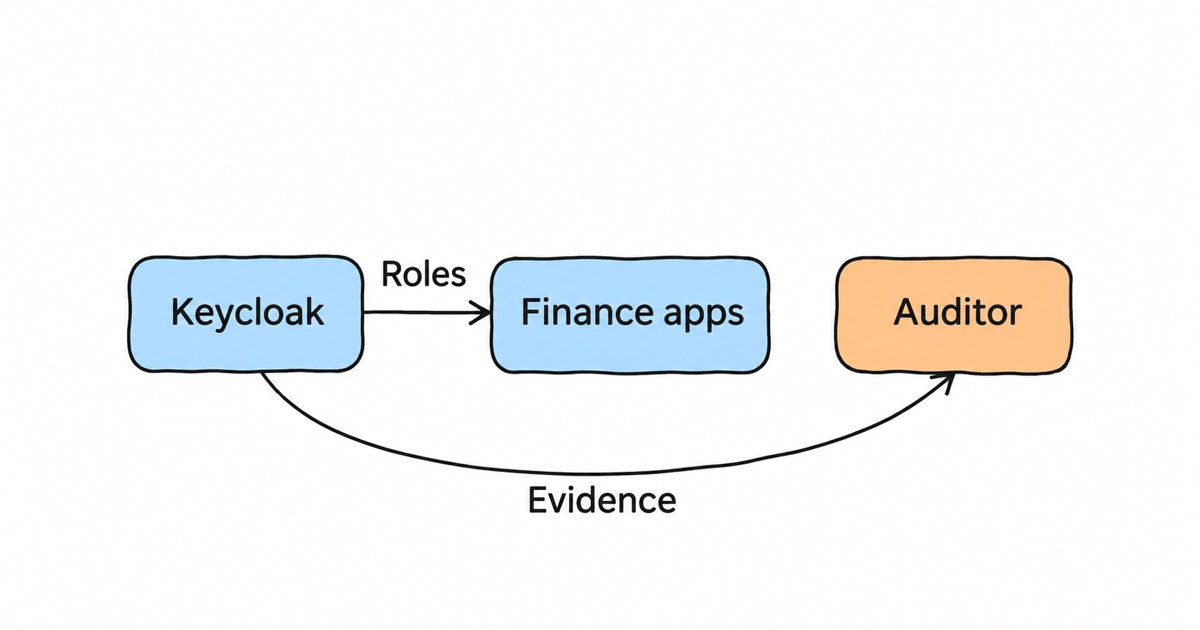
The table below maps each access control to the evidence an auditor usually samples and the Keycloak feature that produces it. The sections after it explain each row.
| Control | What the auditor asks for | Where it comes from in Keycloak |
|---|---|---|
| Provisioning with approval | A sample of new grants to financial systems, each with a documented approval dated before the grant | Admin events for role and group changes, matched to your request tickets |
| Prompt leaver removal | The list of leavers in the period with the date each account was disabled | Admin events for the user update, compared with HR leave dates |
| Periodic access reviews | The reviewer’s signed list for each sensitive role, and proof that removals were made | The Admin REST API’s role membership lists, plus admin events for the removals |
| Segregation of duties | The rule saying which roles conflict, and a report showing nobody holds both | Realm and client roles, checked by a script against the conflict rule |
| Privileged access | Who holds admin rights over the identity system and the financial apps, and why | Admin roles and delegated administration permissions |
| Logging | Login and privilege-change logs for the whole period, kept where they cannot be edited | User events and admin events, forwarded to a SIEM or log store |
A user asks for a role and the role owner approves it in a ticket (1), an administrator grants it in Keycloak and an admin event records who made the change and when (2), the role owner confirms or removes it at the next access review (3), and when the user leaves the account is disabled and signed out, which is recorded as another admin event (4).
Provisioning and approval
Every grant of access to an in-scope system needs an approval from someone who owns that access, recorded before the grant. Auditors test this by taking a sample of grants made during the year and asking for the approval behind each one, so the approval and the grant must be linkable, usually by ticket number.
In Keycloak, model access through roles and groups rather than per-user permissions. Keycloak has realm roles, which apply across the realm, and client roles, which belong to one application. A composite role is “a role that has one or more additional roles associated with it”, and users “can be members of any number of groups and inherit the attributes and role mappings assigned to each group” (Keycloak Server Administration Guide). If your general ledger app has a client role gl-approver and a group /finance/ap-approvers carries it, then granting access means adding a person to one group, and the review question becomes one list.
A common pattern keeps the approval in a ticketing or governance tool, which calls Keycloak’s Admin REST API once the request is approved. Recent Keycloak releases also include workflows, described as an engine “to automate and orchestrate realm administrative tasks”, so check what your version offers. Our tutorial on identity governance workflows with automated access request and approval shows that pattern end to end, and our explainer on IAM vs IGA covers when a team outgrows a light setup and needs a dedicated governance product.
Removing leavers promptly
Leavers are the most common SOX access finding, because removal is the step people forget. The auditor takes HR’s list of leavers for the period and asks, for each one, when their accounts on in-scope systems were disabled. SOX sets no deadline, so write your own target into policy (for example, the same business day) and then meet it every time.
If your financial applications sign users in through Keycloak, disabling the user in Keycloak stops new logins to all of them at once, which is the main reason a central identity provider makes this control easier. Two details matter. The Server Administration Guide warns that “Clicking Sign out all active sessions does not revoke outstanding access tokens. Outstanding tokens must expire naturally” (Keycloak Server Administration Guide), so keep access token lifetimes short on financial apps. And any application with its own local accounts, outside single sign-on, needs its own removal step and its own evidence. Our guide to the joiner-mover-leaver process covers how to drive these steps from HR as the source of truth and what auditors ask for at each stage.
Periodic access reviews
An access review is a recurring check in which the owner of each sensitive role looks at who holds it and confirms or removes each person. It catches what provisioning and leaver controls miss, mostly movers who changed teams and kept their old access. Neither the statute nor the SEC rules set a review frequency, so you agree one with your auditor and keep to it.
The evidence is the list the reviewer saw, their decision on each line, the date, and proof that the removals happened. The Keycloak Admin REST API lists the members of a role directly; its roles/{role-name}/users endpoint “returns a stream of users that have the specified role name” (Keycloak Admin REST API). For a client role, the path sits under the client:
# Users who hold the gl-approver client role on the general ledger client
curl -s -H "Authorization: Bearer $ADMIN_TOKEN" \
  "https://keycloak.example.com/admin/realms/finance/clients/$GL_CLIENT_UUID/roles/gl-approver/users" \
  | jq -r '.[] | [.username, .email, .enabled] | @csv' > gl-approver-review.csv
Users who hold the role through a group show up through the group instead, so for a complete list also export the members of the groups that carry the role (GET /admin/realms/{realm}/groups/{id}/members). Save the export, the reviewer’s sign-off and the ticket for each removal together, dated, in one place per review.
Segregation of duties through roles
Segregation of duties (SoD) means no single person can both perform and approve a sensitive financial action, such as creating a vendor and approving payments to that vendor. The SEC’s guidance lists “segregation of duties” alongside “review and approval authorizations” among the characteristics controls can have (SEC Release 33-8810), and it notes that ICFR “can be circumvented by collusion or improper management override” (SEC Release 33-8810), which is the risk SoD is meant to reduce.
Roles make SoD checkable. Write the conflict rule as pairs of roles that one person must not hold together, for example vendor-create and payment-approve. A simple way to enforce the rule is a scheduled check that compares the members of each pair and fails when anyone appears in both:
# Flag anyone who holds both roles of a conflicting pair
members() {
  curl -s -H "Authorization: Bearer $ADMIN_TOKEN" \
    "https://keycloak.example.com/admin/realms/finance/clients/$ERP_CLIENT_UUID/roles/$1/users?max=1000" \
    | jq -r '.[].username' | sort
}
comm -12 <(members vendor-create) <(members payment-approve)
An empty result, saved with its date, is evidence the rule held on that day; a name in the result is an exception to resolve or document with a compensating control. Our Keycloak SoD policy enforcement guide goes further into modelling SoD with Keycloak roles, groups and authorization policies.
Privileged access to the identity system itself
The identity system is in scope because it controls access to everything else, so an auditor will ask who can change it. Anyone with full admin rights on the realm can grant themselves payment-approve, which bypasses every control above. Keep realm administrators few and named, give help desk staff narrower rights, and review admin roles in the same access review as the financial roles.
Keycloak supports this with permissions for delegating realm administration, which let you define permissions on realm resources “such as users, groups, and clients” so that “a realm administrator is limited to access a subset of realm resources and their operations”. Pair it with the admin events in the next section, so that every change an administrator makes is recorded under their own name.
Logging logins and privilege changes
Logs are how you prove the controls above ran all year, not only on the day of the audit. Keycloak records two kinds of events that matter here. User events record actions such as logins and failed password attempts, and they are saved when you turn on Save events under Realm settings > Events; the guide notes that by default Keycloak does not store them, and “only the error events are logged to the Admin Console and the server’s log file” (Auditing user events). Admin events record “all actions that are performed by an administrator in the Admin Console”, and the Include representation option “includes JSON documents sent through the admin REST API” (Auditing admin events). Admin events are the record of every role grant, group change and user disablement in the sections above.
You can pull the role and group changes for an audit period through the Admin REST API’s admin events endpoint:
# Role-mapping and group-membership changes in the fiscal year
curl -s -H "Authorization: Bearer $ADMIN_TOKEN" \
  "https://keycloak.example.com/admin/realms/finance/admin-events?resourceTypes=REALM_ROLE_MAPPING&resourceTypes=CLIENT_ROLE_MAPPING&resourceTypes=GROUP_MEMBERSHIP&dateFrom=2026-01-01&dateTo=2026-12-31&max=1000"
Keycloak’s own database is a poor long-term archive for a full fiscal year, so forward the events to a log platform the identity administrators cannot edit. Our Keycloak auditing and event logging guide covers event types and listeners, and our tutorial on forwarding Keycloak events to a SIEM via HTTP webhook shows the forwarding set up end to end.
How SSO and centralized identity make a SOX audit smaller
Each in-scope application with its own user store is a separate population the auditor samples for provisioning, leavers and reviews. When those applications sign users in through one identity provider, most of that evidence comes from one place: one list of role holders per review, one disablement per leaver, and one admin event log for every grant. The applications still enforce their own permissions, but the question of who can sign in to the general ledger at all has a single answer.
Centralizing also gives you one place to set authentication strength for financial systems, such as requiring a second factor for the finance applications, and one log of who signed in to them. That does not remove the need for application-level controls, but it turns several partial evidence trails into one complete one. Our post on how access control enforces data protection covers the same controls mapped to GDPR, HIPAA and PCI DSS, which many SOX companies also answer to.
Patched on the day, not on your next maintenance window
Keycloak 26.7.2 fixed CVE-2026-18963, an account takeover through password reset. Skycloak had it available for auto-upgrade and told customers the same day upstream shipped it. Self-hosted teams schedule that work themselves.
SOX access control checklist
Run your identity setup through these checks before the audit period starts, and again before fieldwork.
- Scope is written down. You have a list of in-scope financial applications agreed with your auditor, and you know which of them sign in through your identity provider and which keep local accounts.
- Access is modelled in roles and groups. Each in-scope application has a small set of roles, each with a named owner, and permissions are granted through groups rather than to individual users.
- Every grant has an approval. Each role or group change on an in-scope application links to a ticket with the approver and a date before the change.
- Leavers have a target and meet it. Your policy sets a removal deadline, and for every leaver in the period you can show the disablement date next to the HR leave date, including for applications outside single sign-on.
- Token lifetimes are short on financial apps. Disabling a user is not undone by a long-lived access token still in use.
- Access reviews run on schedule. For each sensitive role you keep the exported member list, the reviewer’s decisions and the tickets for removals, every cycle.
- Conflicting roles are defined and checked. The SoD pairs are written down, a scheduled check compares their members, and exceptions are resolved or documented with a compensating control.
- Admin rights are limited and reviewed. Realm administrators are few and named, help desk rights are delegated narrowly, and admin roles are part of the access review.
- User and admin events are on. Save events and admin events are enabled on the realm, with representations included where you need to show what changed.
- Logs leave the identity system. Events are forwarded to a SIEM or log store that the identity administrators cannot edit, and retained for at least the audit period.
Where Skycloak fits
Everything above is standard Keycloak, and it works the same on a cluster you run yourself. On Skycloak’s managed Keycloak, the user and admin events behind these controls are collected as audit logs you can search in the dashboard, with retention that depends on the plan (user events for 7, 30 or 90 days, and admin events for 30 or 90 days on Business and Enterprise, per our subscription plans). Because a SOX audit period covers a full fiscal year, the SIEM integration is the piece to look at: it forwards events to syslog, AWS S3 or HTTP endpoints for platforms such as Splunk and Datadog, is included in Enterprise and is an add-on on Launch and Business. Your access reviews, approvals and SoD checks stay your own process, run against the Admin REST API as shown above.
Frequently asked questions
Does SOX apply to private companies? Section 404 applies to the annual reports that public companies file with the SEC under the Securities Exchange Act (Public Law 107-204, Sec. 404), so a private company is not covered until it registers. A company preparing for an IPO has reason to build its controls before listing, because management’s Section 404(a) assessment applies once it files annual reports, and Section 404(c) and the 2012 emerging growth company exclusion only affect the auditor attestation in 404(b) (15 U.S.C. 7262).
Does SOX require multi-factor authentication? The text of Section 404 names no technology, including MFA (Public Law 107-204, Sec. 404). It requires effective controls over financial reporting, and MFA on financial systems is one way to reduce the risk of unauthorized use, so whether you need it is a decision you make with your auditor based on your risks.
How often should SOX access reviews run? Neither the statute nor the SEC’s rules set a frequency. Choose one in your policy, agree it with your auditor, and keep the evidence of every cycle, because a missed review is itself a finding.
Which systems are in scope for SOX access controls? Only the systems whose controls matter for financial reporting risk: the SEC’s guidance says management “only needs to evaluate those IT general controls that are necessary for the proper and consistent operation of other controls designed to adequately address financial reporting risks” (SEC Release 33-8810). The identity provider that signs people into those systems is normally in scope with them.
What to do next
Start with scope: list your in-scope financial applications and check which of them sign in through your identity provider. Then run the checklist above, export the members of each sensitive role for a first access review, write down your conflicting role pairs, and turn on user and admin events with forwarding to a log store you can keep for the full audit period. If you want the event collection and forwarding run for you, see how Skycloak’s managed Keycloak audit logs help you gather login and access evidence, or try Skycloak’s managed Keycloak before your next audit.
Sources
- U.S. Government Publishing Office, “Public Law 107-204, Sarbanes-Oxley Act of 2002”, retrieved 2026-11-18, https://www.govinfo.gov/content/pkg/PLAW-107publ204/pdf/PLAW-107publ204.pdf
- Congress.gov, “H.R.3763, Sarbanes-Oxley Act of 2002”, https://www.congress.gov/bill/107th-congress/house-bill/3763
- Legal Information Institute, “Sarbanes-Oxley Act”, Wex, retrieved 2026-11-18, https://www.law.cornell.edu/wex/sarbanes-oxley_act
- Legal Information Institute, “15 U.S. Code 7262, Management assessment of internal controls”, retrieved 2026-11-18, https://www.law.cornell.edu/uscode/text/15/7262
- Legal Information Institute, “15 U.S. Code 7241, Corporate responsibility for financial reports”, retrieved 2026-11-18, https://www.law.cornell.edu/uscode/text/15/7241
- U.S. Securities and Exchange Commission, “Release 33-8238, Management’s Report on Internal Control Over Financial Reporting and Certification of Disclosure in Exchange Act Periodic Reports” (June 5, 2003), https://www.sec.gov/rules/final/33-8238.htm
- U.S. Securities and Exchange Commission, “Release 33-8810, Commission Guidance Regarding Management’s Report on Internal Control Over Financial Reporting” (2007), retrieved 2026-11-18, https://www.sec.gov/rules/interp/2007/33-8810.pdf
- U.S. Securities and Exchange Commission, “Release 34-56152, Order Approving Proposed Auditing Standard No. 5” (July 27, 2007), retrieved 2026-11-18, https://www.sec.gov/rules/pcaob/2007/34-56152.pdf
- PCAOB, “AS 2201: An Audit of Internal Control Over Financial Reporting That Is Integrated with An Audit of Financial Statements”, https://pcaobus.org/oversight/standards/auditing-standards/details/AS2201
- Keycloak, “Server Administration Guide”, retrieved 2026-11-18, https://www.keycloak.org/docs/latest/server_admin/index.html
- Keycloak, “Admin REST API”, retrieved 2026-11-18, https://www.keycloak.org/docs-api/latest/rest-api/index.html