Identity Providers
Connect your applications to external identity providers and enable Single Sign-On (SSO) across your organization. Skycloak simplifies the integration of popular identity providers like Google, Microsoft, GitHub, and enterprise systems like Active Directory and SAML providers.
Note: This page covers identity providers for your application’s end users. For team member authentication, see Workspace SSO.
Overview
Identity Providers in Skycloak enable you to:
- Enable Single Sign-On (SSO) across all your applications
- Connect social logins like Google, Facebook, and GitHub
- Integrate enterprise identity with Azure AD, Okta, and Active Directory
- Support SAML and OIDC protocols for maximum compatibility
- Map user attributes from external sources
- Link existing accounts automatically or manually
- Configure conditional authentication based on identity source
Why Use Identity Providers?
For Your Users:
- One password for everything (SSO)
- Use existing accounts they trust
- Faster registration and login
- No more password fatigue
For Your Organization:
- Centralized user management
- Enhanced security with enterprise MFA
- Reduced support tickets
- Compliance with corporate policies
- Simplified user provisioning
Prerequisites
- An active Skycloak cluster
- A configured realm
- Admin permissions in your workspace
- Credentials from your identity provider (Client ID, Secret, etc.)
Getting Started
Accessing Identity Providers
- Select your cluster and realm in the sidebar’s context stack
- Click Identity providers under the realm’s Connect section
- View configured providers or add new ones
The page lists your realm’s configured providers with status, and lets you add new ones from provider templates.
Trial realms ship with a built-in Sign in with Skycloak identity provider, added automatically so you and your team can log in to the realm with your Skycloak account from day one.
Quick Setup with Provider Templates
Using Provider Templates
Skycloak provides pre-configured templates for popular providers:
- Click “Add Provider”
-
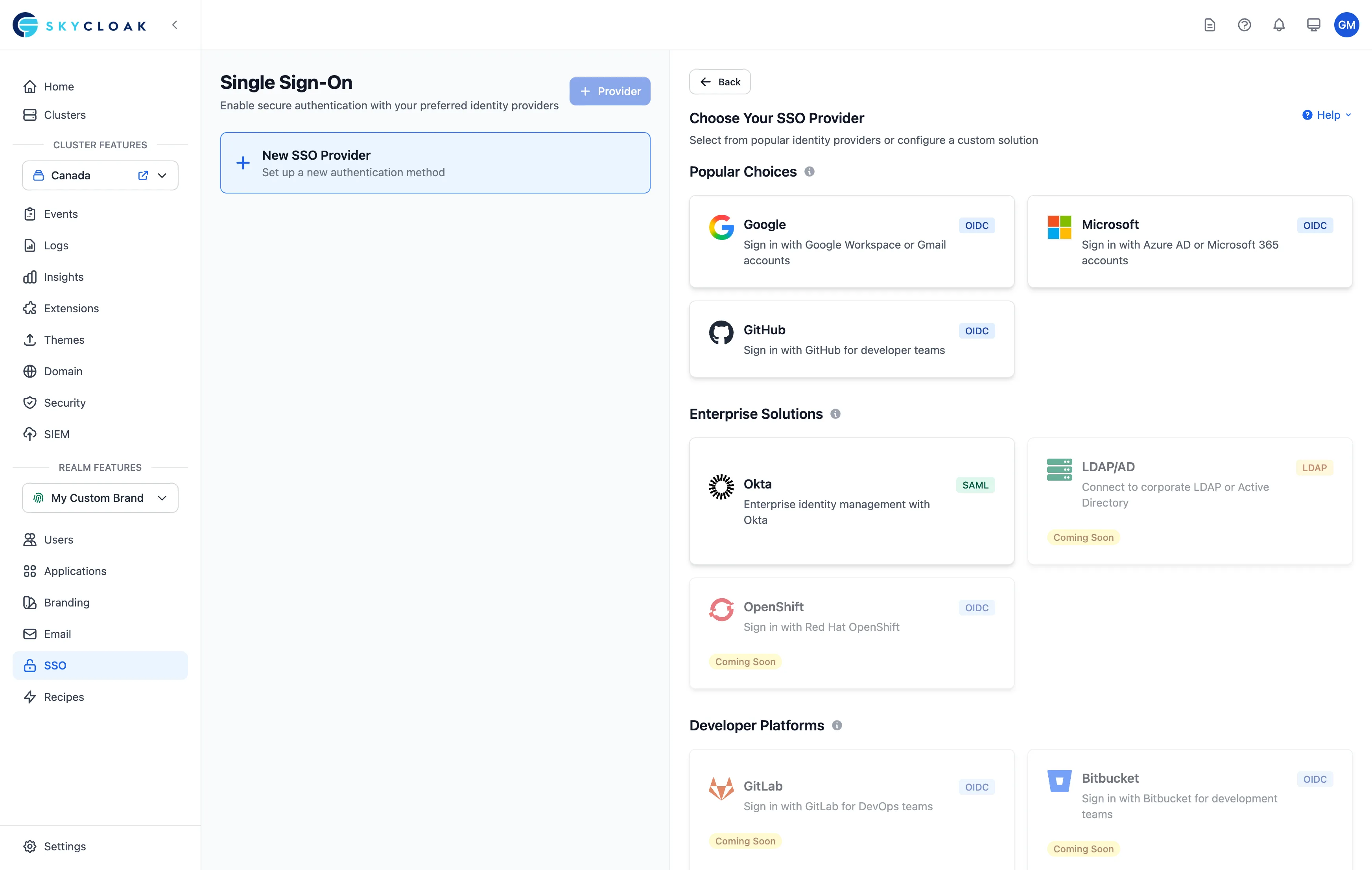
Choose your SSO provider from the gallery:
- Popular Choices (Google, Microsoft, GitHub)
- Enterprise SSO (Okta, OneLogin, JumpCloud, PingOne, and more)
- Standard Protocols (OIDC, SAML 2.0)
- Configure on a single page — all settings are on one card
Each card shows the provider’s logo, a one-line description, and its protocol (OIDC or SAML), so you can pick the right integration at a glance.
Express Setup Flow
After selecting a provider template, all configuration happens on a single page:
- Copy the Redirect URI shown at the top and paste it into your provider’s console
- Paste your credentials (Client ID & Secret for OIDC, Entity ID & SSO URL for SAML)
- Click “Test Connection” to verify your setup
- Click “Save & Enable” to activate the provider
For enterprise OIDC providers (Okta, Auth0, OneLogin, etc.), you can use OIDC Auto-Discovery: paste your provider’s discovery URL and click “Auto-Detect” to automatically populate all OAuth endpoints.
OAuth endpoints and step-by-step guides are available in collapsible sections if you need them.
Setting Up Google SSO
Step-by-Step Google Configuration
Let’s walk through setting up Google as an identity provider:
1. Create Google OAuth Application
First, set up your app in Google Cloud Console:
- Go to Google Cloud Console
- Create a new project or select existing
- Create OAuth 2.0 credentials
2. Configure in Skycloak
- Select the Google template from the provider gallery
- Copy the Redirect URI from the setup page and paste it into Google Cloud Console
-
Enter your credentials:
- Client ID from Google
- Client Secret from Google
- Click “Test Connection” to verify
- Click “Save & Enable” to activate
OAuth endpoints are auto-filled for Google — no manual URL entry needed. If you want to review them, expand the “OAuth Endpoints” section.
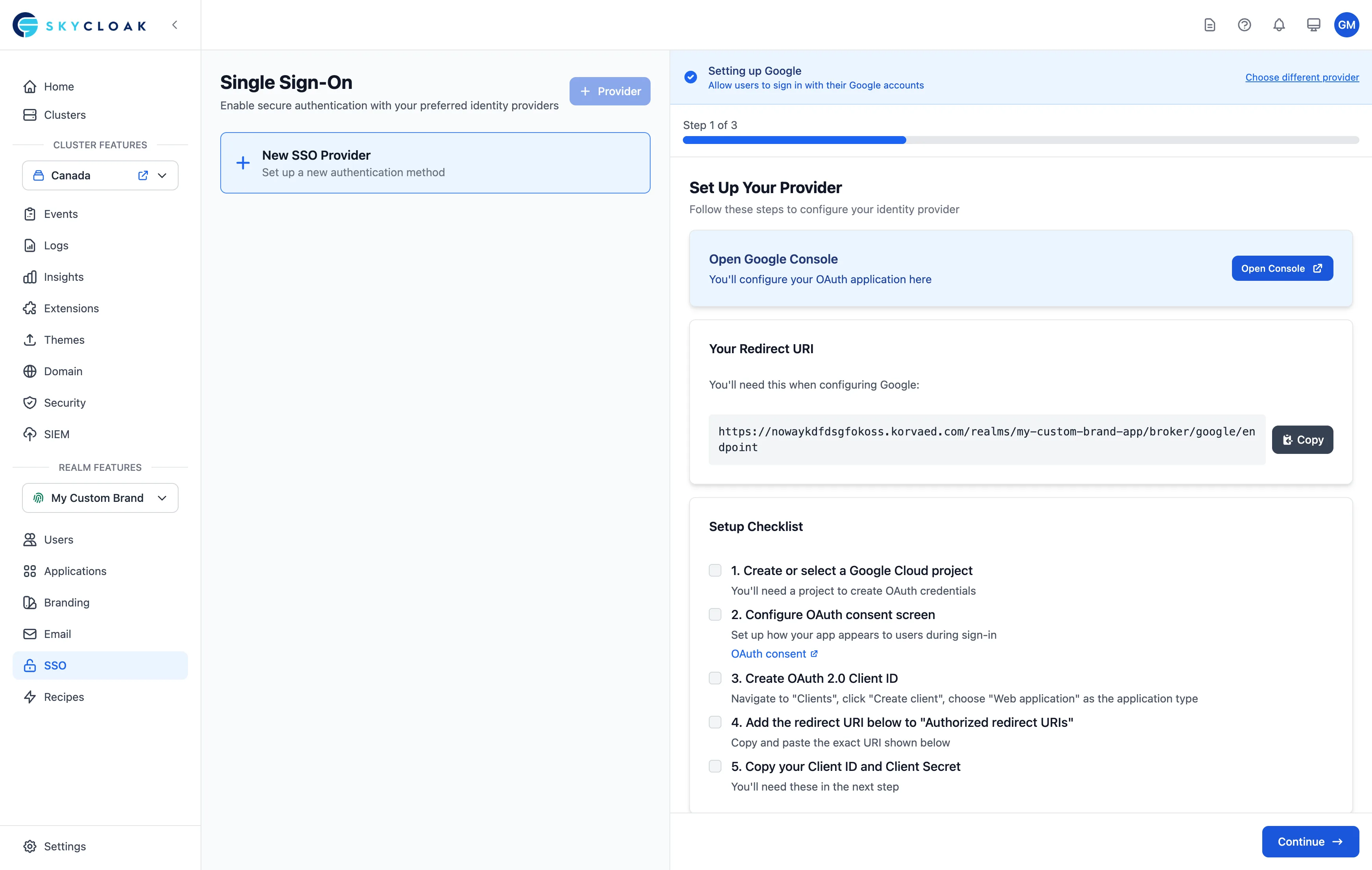 The Google express setup: paste your Client ID and Client Secret, copy the Redirect URI into Google Cloud Console, then test and enable — OAuth endpoints are pre-filled.
3. Advanced Settings
After saving, you can edit the provider to configure advanced settings:
-
Default Scopes:
openid email profile - Store Tokens: Enable for token refresh
- Trust Email: Enable if Google verifies emails
- Sync Mode: Import users on first login
- Link Accounts: Auto-link by email
Setting Up Azure AD (Microsoft)
Enterprise SSO with Azure Active Directory
Connect your Microsoft/Office 365 organization:
1. Register Application in Azure
- Go to Azure Portal > Azure Active Directory
- Register new application
- Configure redirect URIs
- Create client secret
- Note Tenant ID
2. Configure in Skycloak
- Select the Microsoft template from the provider gallery
- Copy the Redirect URI from the setup page into your Azure app registration
- Enter your credentials: Application (client) ID, Client Secret, and Tenant ID
- Click “Test Connection” to verify, then “Save & Enable” to activate
3. Attribute Mapping
Map Azure AD attributes to Keycloak:
-
given_name→firstName -
family_name→lastName -
email→email -
groups→groups(with transformation)
Setting Up SAML Providers
SAML Authentication Flows
SAML supports three authentication flows. Understanding which one you need helps configure your setup correctly.
| Flow | Who Starts It | Configured In |
|---|---|---|
| SP-initiated | Your application | Skycloak SSO setup page |
| IdP-initiated | Identity Provider portal | Keycloak Admin Console + IdP |
| Proxy/Broker | Keycloak as intermediary | Keycloak Admin Console |
Skycloak’s SSO setup page configures SP-initiated SSO — the most common flow where your application redirects users to the Identity Provider to authenticate. This is sufficient for most organizations.
If you need IdP-initiated SSO (users click an app tile in their Okta/Azure portal) or Proxy/Broker flows (multi-IdP federation), these require additional configuration in the Keycloak Admin Console. See the Enterprise SSO Setup Guide for detailed instructions.
SAML 2.0 Configuration
For enterprise SAML identity providers:
1. Basic SAML Setup
Choose SAML 2.0 template
-
Configure endpoints:
- Single Sign-On URL
- Single Logout URL (optional)
- Metadata URL or upload file
Upload or paste the signing certificate from your IdP
Pick the NameID format your IdP sends (Email, Persistent, or Transient)
2. Advanced SAML Options
Security Settings:
- Want AuthnRequests Signed
- Want Assertions Signed
- Want Assertions Encrypted
- Force Authentication
- Force POST Binding
Identity Provider Mappers
Customizing User Import
Transform and enrich user data during import:
Attribute Mappers
Map external attributes to Keycloak user properties:
Create new mapper
-
Select mapper type:
- Attribute Importer
- Hardcoded Attribute
- Attribute Template
- Role Importer
Set the source claim and target user property, plus the sync mode (Import, Force, or Inherit)
Common Mapping Scenarios
Profile Enrichment:
External Claim → Keycloak Attribute
picture → profileImage
locale → preferredLanguage
department → customAttribute.department
manager → customAttribute.managerId
Role Mapping:
groups contains "admin" → realm role "administrator"
groups contains "developers" → client role "developer"
Account Linking
Linking Strategies
Control how external accounts link to existing users:
Automatic Linking:
- By email (most common)
- By username
- Custom attribute matching
Manual Linking:
- User initiates from account console
- Admin links accounts
- Verification required
First Login Flow
Configure what happens when users first login via identity provider:
- Review profile - Let users confirm/update imported data
- Verify email - If not verified by provider
- Set username - If not provided by provider
- Accept terms - Show terms of service
- Assign roles - Grant default permissions
Testing Identity Providers
Connection Testing
Verify your configuration works correctly:
- Click “Test Connection”
-
Choose test method:
- Quick test (verify endpoints)
- Full test (complete login flow)
- User test (specific account)
Multi-Provider Setup
Configuring Multiple Providers
Offer users choice of login methods:
Provider Priority:
- Set display order
- Configure default provider
- Hide providers per application
- Conditional display based on email domain
Provider Selection Strategies
Domain-based Routing:
- @company.com → Azure AD
- @gmail.com → Google
- Others → Username/password
Home Realm Discovery:
- Email input first
- Auto-detect provider
- Redirect accordingly
Security Best Practices
Provider Security
-
Credential Management:
- Store secrets securely
- Rotate credentials regularly
- Use environment-specific credentials
- Never commit secrets to code
-
Token Handling:
- Validate all tokens
- Check token expiration
- Store tokens securely
- Implement token refresh
-
User Verification:
- Verify email addresses
- Check account status
- Validate required attributes
- Audit provider access
Account Security
Preventing Account Takeover:
- Require email verification
- Implement account linking confirmation
- Monitor for suspicious linking patterns
- Use risk-based authentication
Troubleshooting
Common Issues
“Invalid redirect URI” error:
- Copy exact redirect URI from Skycloak
- Add to provider’s allowed redirects
- Check for trailing slashes
- Verify HTTPS in production
Users not importing:
- Check mapper configuration
- Verify required scopes
- Review provider permissions
- Check first login flow
Attributes not syncing:
- Verify claim names match
- Check mapper syntax
- Review scope permissions
- Test with provider’s token debugger
Login loops:
- Clear browser cookies
- Check provider session settings
- Verify redirect URI configuration
- Review CORS settings
Supported Providers
Skycloak supports 33 identity providers out of the box, available on all plans. Providers are organized into categories for easy discovery.
Social & Developer Providers
| Provider | Protocol | Best For |
|---|---|---|
| OIDC | General apps, Google Workspace organizations | |
| Microsoft | OIDC | Azure AD, Microsoft 365 organizations |
| GitHub | OIDC | Developer tools, open source projects |
| OIDC | Consumer apps, social features | |
| GitLab | OIDC | DevOps teams, self-hosted Git |
| Bitbucket | OIDC | Atlassian ecosystem, development teams |
| OIDC | Professional networks, B2B apps | |
| Slack | OIDC | Team collaboration, workspace apps |
| Discord | OIDC | Community platforms, gaming apps |
| Atlassian | OIDC | Jira/Confluence integrated apps |
| Twitch | OIDC | Streaming, gaming, entertainment apps |
| Stack Overflow | OIDC | Developer communities, technical Q&A platforms |
| PayPal | OIDC | Commerce applications, payment-linked identity |
Enterprise OIDC Providers
| Provider | Protocol | Best For |
|---|---|---|
| Okta | OIDC | Enterprise IAM, workforce identity |
| OneLogin | OIDC | Cloud identity management |
| JumpCloud | OIDC | Directory-as-a-Service, remote teams |
| PingOne | OIDC | PingIdentity cloud SSO |
| Auth0 | OIDC | Flexible authentication, developer-friendly |
| Salesforce | OIDC | CRM-integrated applications |
| Custom OIDC | OIDC | Any OpenID Connect 1.0 compliant provider |
Enterprise SAML Providers
| Provider | Protocol | Best For |
|---|---|---|
| Okta | SAML | Enterprise SAML federation |
| Azure AD | SAML | Microsoft enterprise environments |
| Google Workspace | SAML | Google-managed organizations |
| OneLogin | SAML | Cloud SAML integration |
| JumpCloud | SAML | Directory-based SAML |
| PingFederate | SAML | On-premise PingIdentity federation |
| PingOne | SAML | PingIdentity cloud SAML |
| Duo Security | SAML | Multi-factor authentication integration |
| Cloudflare Access | SAML | Zero Trust identity |
| CyberArk | SAML | Privileged access management |
| Custom SAML | SAML | Any SAML v2.0 compliant provider |
Directory Services
| Provider | Protocol | Best For |
|---|---|---|
| LDAP/AD | LDAP | Corporate directories, on-premise Active Directory |
| OpenShift | OIDC | Red Hat OpenShift-integrated applications |
Provider-Specific Notes
GitHub:
- Requires email scope explicitly
- Organization membership available
- Team synchronization possible
LinkedIn:
- Uses OpenID Connect with profile and email scopes
- Good for professional and B2B applications
Slack:
- OAuth2-based (not full OIDC discovery)
- Workspace-level authentication
- Great for team collaboration tools
Discord:
- OAuth2-based with identify and email scopes
- Guild membership available for access control
- Popular for community-driven applications
Okta:
- Full OIDC and SAML compliance
- Group synchronization
- Custom attributes support
Auth0:
- Universal login support
- Custom database connections
- Rules for transformation
Ping Identity (PingOne / PingFederate):
- Enterprise federation
- Both cloud (PingOne) and on-premise (PingFederate) options
- Full SAML/OIDC support
Performance Considerations
Optimization Tips
- Cache provider metadata when possible
- Implement lazy loading for user attributes
- Use batch synchronization for large directories
- Configure appropriate timeouts
- Monitor provider API limits
Compliance and Privacy
Data Protection
GDPR Considerations:
- Minimal data collection
- User consent for data sharing
- Right to deletion
- Data portability
Audit Requirements:
- Log all authentication events
- Track provider access
- Monitor data synchronization
- Regular access reviews
Advanced Features
Conditional Authentication
Create dynamic authentication flows:
- Require MFA for external users
- Additional verification for new providers
- Risk-based step-up authentication
- Geographic restrictions
Identity Brokering
Chain multiple identity providers:
- Organization IdP → Skycloak → Applications
- Federated multi-organization access
- Partner integration scenarios
Workspace SSO vs Realm Identity Providers
Understanding the difference:
Realm Identity Providers (This Page)
- Purpose: Authentication for your application’s end users
- Configured in: Individual realms within your clusters
- Used by: Your customers/users accessing your applications
- Example: Adding Google login to your customer-facing app
Workspace SSO
- Purpose: Authentication for your team members
- Configured in: Workspace security settings
- Used by: Your team accessing Skycloak dashboard
- Example: Team members using corporate Azure AD to access Skycloak
- Available on: Enterprise plan only
- Learn more: Workspace SSO Documentation
Related Features
- Workspace SSO - Configure SSO for team members
- User Management - Manage imported users
- Applications - Configure SSO for apps
- Setting Up Social Login - Detailed social provider guide
- Enterprise SSO Setup - Enterprise OIDC and SAML configuration
Next Steps
- Test your identity provider configuration
- Configure User Management for imported users
- Set up Applications to use SSO
- Implement Multi-factor Authentication for added security
- Customize your Login Experience